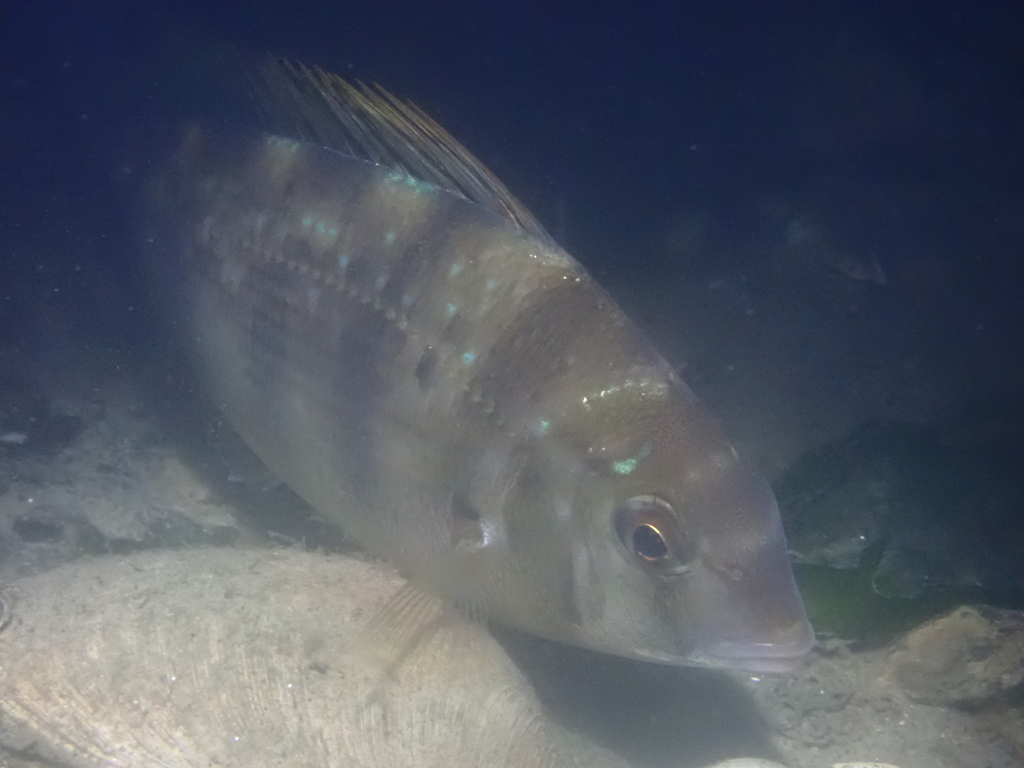
Photo: Zakqary Roy
Feravox · The Voice of the Wild
Scup
Stenotomus chrysops
Near Threatened
Scup (Stenotomus chrysops) lives in coastal shelf habitats across Massachusetts to South Carolina. It feeds on squid, worms, clams. Its conservation status is Near Threatened.
The scup (Stenotomus chrysops) is a sleek, silvery member of the Sparidae family that glides along the Atlantic seaboard from Massachusetts to South Carolina. Reaching up to 18 in (460 mm) and 3–4 lb (1.4–1.8 kg) at its maximum, most individuals weigh only 0.5–1.0 lb (0.23–0.45 kg). Their bodies are laterally compressed, a shape that aids swift maneuvering over sandy and weedy bottoms where they lay their eggs. Females begin reproducing at two years old, depositing roughly 7,000 eggs each spring in the protective embrace of sand and seaweed, and the larvae drift into inshore and estuarine waters where they find abundant food. By age two or three they are fully mature, spending winters on the mid- and outer continental shelf before migrating inshore as temperatures rise, a seasonal rhythm that underpins the species’ life cycle. Scup are opportunistic feeders, snapping up squid, sand-worms, and clams, dietary staples that also make these items the bait of choice for anglers. Their flesh is firm, flaky, and sweet-ish, reminiscent of shrimp, earning them a place on both the pan-fish table and, surprisingly, in sushi rolls. Historically the most abundant fish in colonial waters, scup have endured intense pressure: commercial trawl fisheries began in 1929, and by the late 20th century the stock was declared overfished in 1996. Yet, thanks to regulated size limits, bag limits, seasonal closures, and quota allocations, 78 % of the annual harvest for commercial vessels and 22 % for recreational anglers in Massachusetts, the species shows signs of a rebound, hinting at a resilience that belies its long-lived, 20-year lifespan.
Real recorded sounds, 11 nature games and a free Daily 5, 1v1 quiz duels, conservation wins and a safe Kids mode. Free on Feravox.