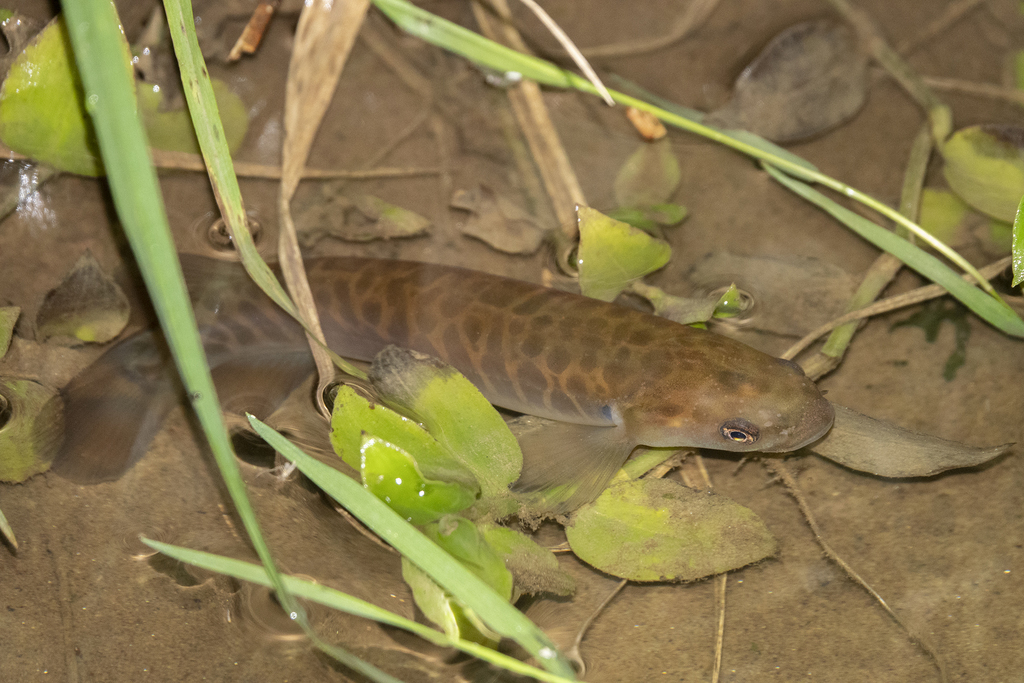
Photo: Sebastian Doak
Feravox · The Voice of the Wild
Banded Kōkopu
Galaxias fasciatus
Least Concern
Banded Kōkopu (Galaxias fasciatus) lives in lowland coastal streams across New Zealand. It feeds on planktonic organisms. Its conservation status is Least Concern.
The banded kōkopu (Galaxias fasciatus) is a stout-bodied galaxiid, its dark, earthy brown or olive hue punctuated by pale yellow vertical bands that either fade toward the dorsal and ventral edges or fork and criss-cross the back. A silver or white mark sits just behind the operculum above the pectoral fin, a reliable field cue that distinguishes it from its giant and short-jawed cousins. Adults typically reach 20–25 cm, though some individuals stretch toward 30 cm, their short, square tail fin and thick, fleshy caudal peduncle flanges giving them a robust silhouette as they navigate the lowland coastal creeks and inland tributaries of New Zealand, including the Chatham and Stewart / Rakiura islands. Primarily nocturnal, these fish glide through moonlit waters, their large down-turned fins and surface-tension-leveraged grip allowing juveniles to scale waterfalls and vertical splash zones, a surprising climbing feat for a fish. After a diadromous early life at sea, they return as whitebait, drawn by adult-produced pheromones to suitable freshwater refuges. Spawning coincides with autumn and early-winter floods, where 2 mm eggs are deposited among leaf litter and vegetation, left to mature in humid air until a second flood releases the hatchlings back to the ocean. Their life span can exceed nine years, with multiple spawning events, making each individual a long-term resident of New Zealand’s dynamic riverine ecosystems.
Real recorded sounds, 11 nature games and a free Daily 5, 1v1 quiz duels, conservation wins and a safe Kids mode. Free on Feravox.