Photo: Mario Barroso
Feravox · The Voice of the Wild
Longnose Stingray
Hypanus guttatus
Near Threatened
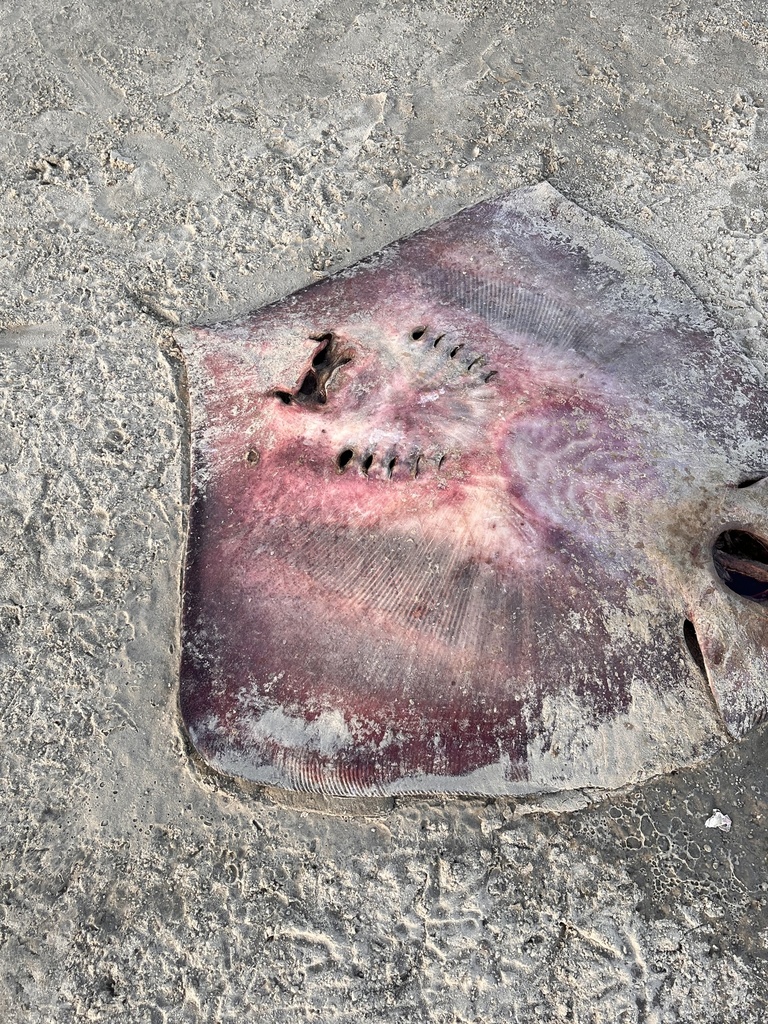
Longnose Stingray (Hypanus guttatus) lives in muddy or sandy coastal across Western Atlantic. It feeds on benthic invertebrates and small fishes. Its conservation status is Near Threatened.
Gliding just above the soft, silty bottoms of the western Atlantic, the longnose stingray (Hypanus guttatus) presents a striking silhouette: a diamond-shaped disc, slightly wider than long, with angular corners that meet at a modestly projecting snout. Its dorsal surface is an olive-brown canvas, occasionally mottled with darker spots, while the ventral side fades to a pale yellow-white. A slender, whip-like tail trails behind, crowned by a single serrated spine near its base, a dorsal keel, and a darkened ventral fin fold that can reach up to four-fifths of the tail’s height. Most individuals measure about 1.25 m (4.1 ft) across, though the disc can expand to a remarkable 2 m (6.6 ft) in the largest females, which also outgrow their male counterparts. In the shallow coastal waters, no deeper than 36 m (118 ft), that fringe the Gulf of Mexico down to Brazil’s Paraná state, these demersal predators hunt benthic invertebrates and small bony fishes. Their pavement-like teeth grind hard-shelled prey such as sea cucumbers, polychaete worms, bivalves, and gastropods, while occasional crustaceans like Penaeus and Callinectes and the grunt Pomadasys corvinaeformis supplement the menu. A surprising facet of their life history is the salinity-driven migration: newborns are born in relatively fresh water, drift into saltier habitats as juveniles, and later return to low-salinity waters for maturation, with known nurseries as shallow as 3 m (9.8 ft) off Brazil’s northeastern coast. This fluid movement between brackish and marine realms underscores the species’ remarkable adaptability, even as it navigates the perils of a venomous tail spine that can surprise beachgoers and fishery workers alike.
Real recorded sounds, 11 nature games and a free Daily 5, 1v1 quiz duels, conservation wins and a safe Kids mode. Free on Feravox.