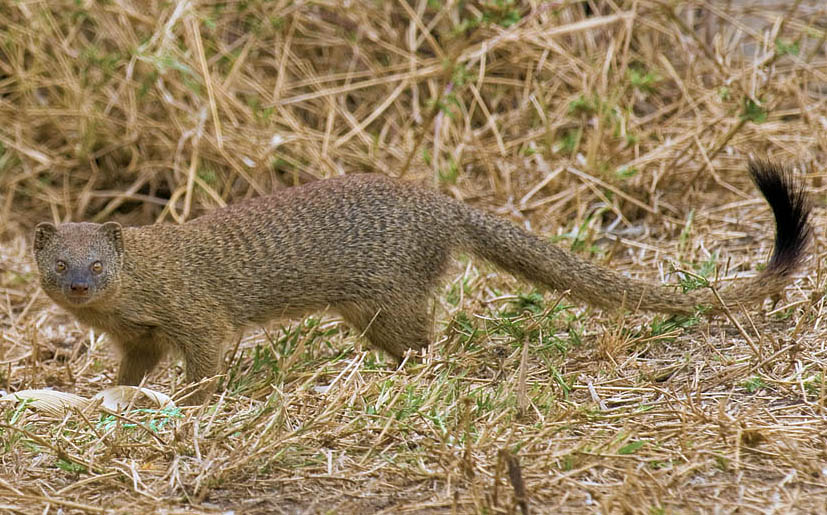
Common Slender Mongoose (Herpestes sanguineus) lives in open savanna across Sub-Saharan Africa. It feeds on insects and rodents. Its conservation status is Least Concern.
Fascinating facts about the Common Slender Mongoose
- A bright black or red tip marks the end of its tail, a feature that distinguishes it from other African mongooses. Its fur colour varies widely between subspecies, ranging from dark reddish-brown to orange-red, grey or golden yellow, and the species also has silkier fur than other African mongooses.
- Although labelled solitary, Kalahari research found they assemble in spatial groups of one to three males and up to four females, sharing a den on roughly one third of nights. The species is primarily diurnal, though it may become active on warm, moonlit nights, and it does not defend strict territories, instead maintaining stable home ranges that overlap with relatives.
- In the Kalahari Desert males stay in their birth area, an unusual pattern for a solitary animal, while females disperse from their natal range. A male's range overlaps the ranges of several females and scent cues alert him when a female is in heat, after which gestation lasts about 60 to 70 days and usually produces one to three young. The male provides no parental care, highlighting the species' atypical sex-biased dispersal strategy.
- The common slender mongoose is more adept at climbing trees than any other African mongoose, allowing it to exploit a vertical hunting niche. From these perches it frequently captures birds, with white-browed sparrow-weavers and glossy starlings listed among its regular prey. This arboreal skill complements its primarily ground-based foraging in savannah and semiarid plains, broadening its dietary options beyond insects and small mammals.
- The slender mongoose can kill and eat venomous snakes, matching the classic mongoose reputation, yet snakes make up only a minor fraction of its meals. Its diet is dominated by insects, which form the bulk of what it consumes, while lizards, rodents, birds, amphibians and occasional fruit are taken when available. This opportunistic feeding strategy lets it switch between prey types seasonally, supporting survival across changing habitats.
Sources
Every fact above was checked against these pages, and kept only where one of them states it.
At a glance
RangeSub-Saharan Africa
HabitatOpen savanna
DietInsects and rodents
About the Common Slender Mongoose
In the sun-drenched savannas, the Common Slender Mongoose weaves a sinuous path, its slender body undulating as it navigates through the tall grasses with effortless ease. With eyes ever-vigilant, this agile hunter darts and pauses, its pointed snout twitching as it tracks the subtlest whispers of its insect prey. As it moves, the mongoose's tawny coat blends seamlessly into the golden light, rendering it all but invisible, a fleeting glimpse of wild beauty in the harsh yet majestic landscape.
Hear the Common Slender Mongoose, and 4,400+ more
Real recorded sounds, 11 nature games and a free Daily 5, 1v1 quiz duels, conservation wins and a safe Kids mode. Free on Feravox.