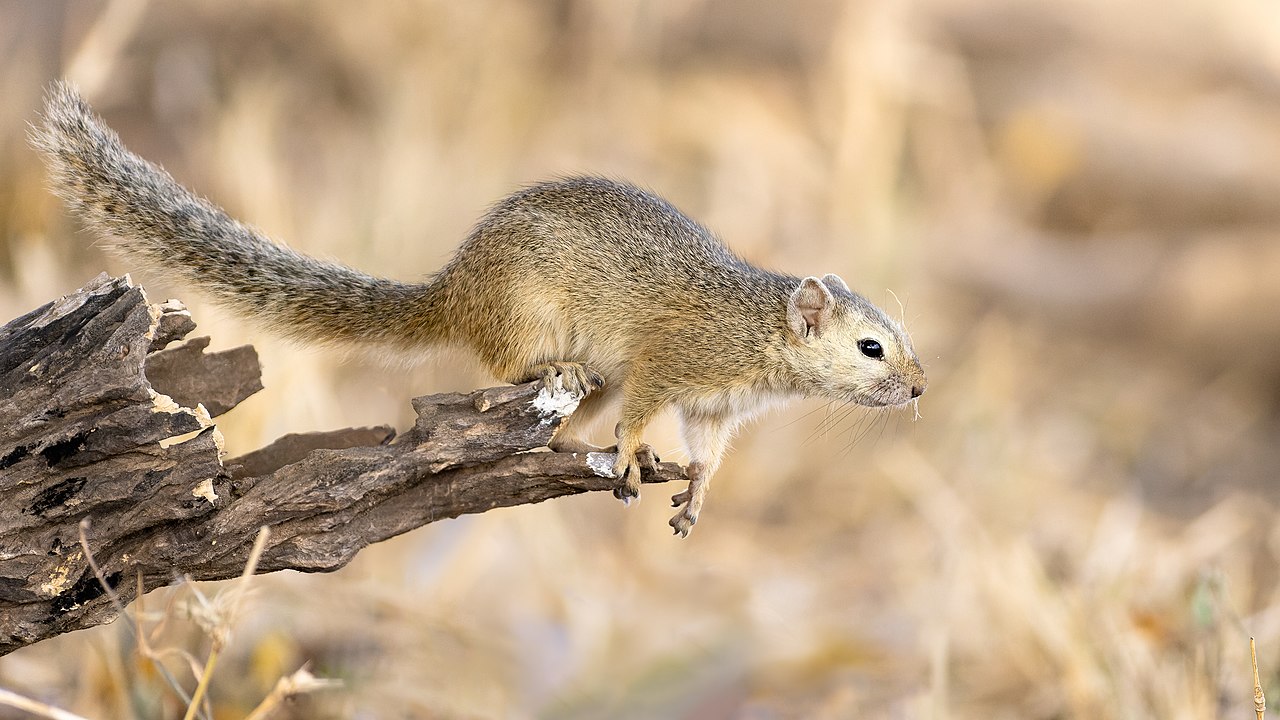
Smith's Bush Squirrel (Paraxerus cepapi) lives in open savanna across Sub-Saharan Africa. It feeds on fruits and insects. Its conservation status is Least Concern.
Hear the Smith's Bush Squirrel
A real field recording of the Smith's Bush Squirrel, made in the wild.
At just 350 mm long, half of which is a flicking tail, Smith's bush squirrels weigh about 200 g. Their coat shifts from pale grey in arid western lands to richer brown in the east, while rusty heads and legs stay constant. They forage for seeds and insects, and raptors and snakes hunt them.
When danger looms, the whole colony erupts in a coordinated "mobbing" display: each squirrel flicks its tail, and the sound grows louder as more individuals join. In solitary situations, a lone squirrel will wedge itself against a trunk, keeping the enemy on the opposite side, then dash to the nearest branch and freeze, flattening against it.
These squirrels scatter-hoard seeds at the bases of trees or in grass tufts, a behavior that unintentionally plants new saplings and sustains savanna regeneration. By moving seeds away from parent trees, they reduce competition and give seedlings a better chance to grow, linking squirrel foraging directly to the health of the ecosystem. Their role as seed dispersers underscores how a tiny rodent can shape the landscape over generations.
Offspring stay in the natal group for months, becoming sexually mature at six to ten months before being forcefully evicted by the breeding pair. The young open their eyes after just 7-9 days, leave the nest at 18-22 days, and are weaned by 29-42 days.
In captivity a Smith's bush squirrel lived 9.6 years. Their average body mass of about 223 g and basal metabolic rate of 145.34 cm³ O₂ g⁻¹ hr⁻¹.
Sources
Every fact above was checked against these pages, and kept only where one of them states it.
In the sun-dappled woodlands of southern Africa, the Smith's Bush Squirrel darts with reckless abandon, its agile form weaving through the underbrush with a fluidity that belies its tiny size. As it moves, the rustle of leaves and snapping of twigs betray its presence, a fleeting glimpse of its striated back and bushy tail a reward for the patient observer. With an irrepressible energy, it scurries up tree trunks and leaps between branches, a whirlwind of activity that imbues the forest with a sense of vibrant, unbridled life.
Advertisement
Hear the Smith's Bush Squirrel, and 4,400+ more
Real recorded sounds, 11 nature games and a free Daily 5, 1v1 quiz duels, conservation wins and a safe Kids mode. Free on Feravox.