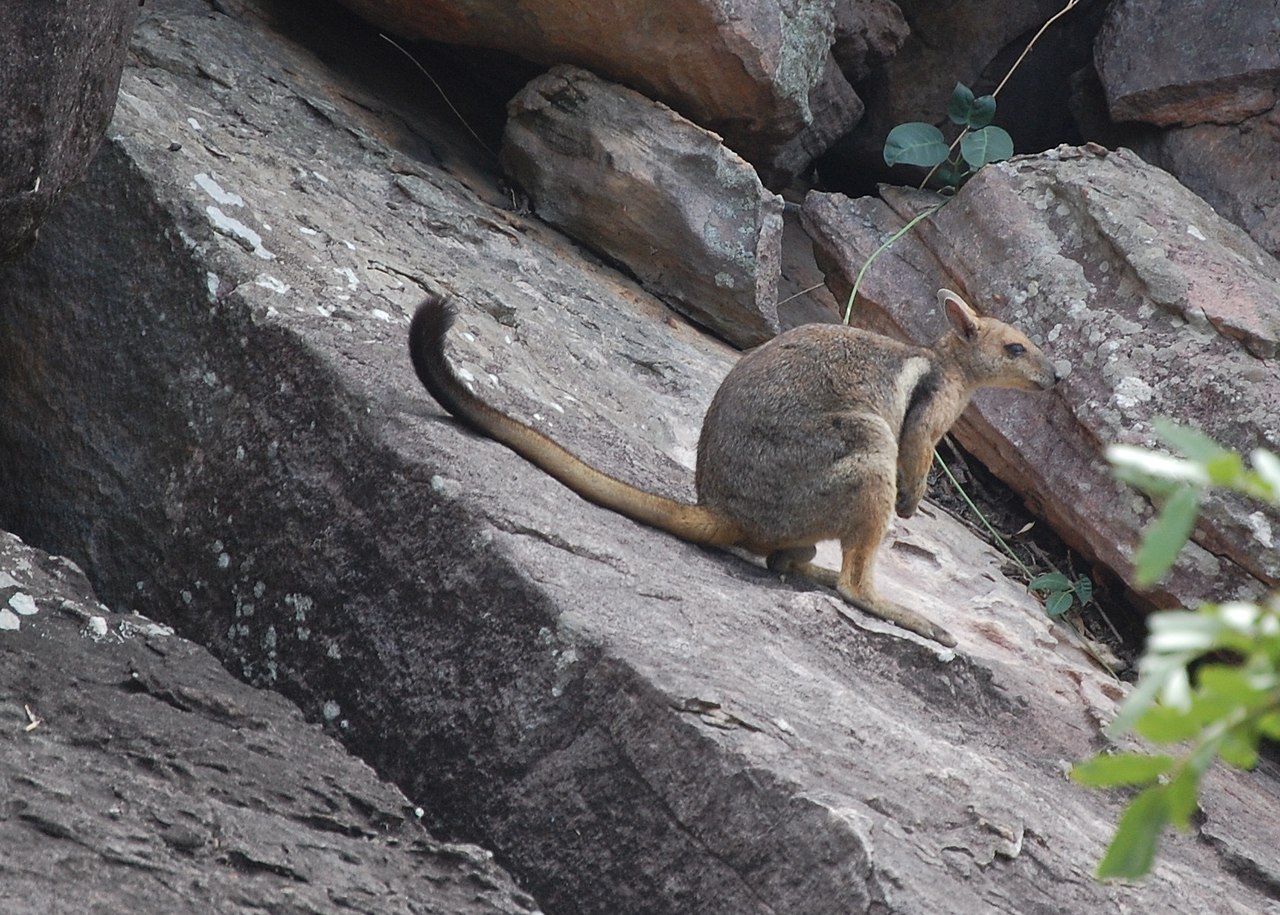
Western Short-eared Rock Wallaby (Petrogale brachyotis) lives in rocky outcrops across Western Australia. Its conservation status is Least Concern.
Fascinating facts about the Western Short-eared Rock Wallaby
- A short-eared rock-wallaby can stretch from nose to tail tip up to 1.07 m, with most adults averaging about 0.97 m in total length, roughly the height of a kitchen countertop. Their bodies weigh between 2.2 kg and 5.5 kg, comparable to a sack of flour, while the tail adds another 0.32-0.55 m of balance-aid. Ears are tiny, only 40-48 mm long, less than half the head length, giving the species its name.
- These wallabies cling to cliffs that receive more than 600 mm of rain each year, a threshold that defines the edge of their inland range. The rainfall creates pockets of monsoonal rainforest and open grassland where fresh shoots and succulent bark are abundant. In dry seasons they survive long without water by munching on the moist bark and roots of trees, a diet that lets them stay hydrated where water holes disappear.
- Unlike many of its rock-wallaby cousins, the short-eared species has not shown a population decline despite the spread of feral rabbits and goats across Australia. Island groups in the Gulf of Carpentera act as safe havens, keeping numbers stable while mainland groups face more pressure. This resilience is reflected in its IUCN rating of Least Concern in 2015, even though exact population trends remain unknown.
- A 2014 genetic and morphological study split the once-broad short-eared rock-wallaby into two species, recognizing the eastern short-eared rock-wallaby (Petrogale wilkinsi) as a separate taxon. The new species lives in Kakadu and Litchfield National Parks, weighs less, and shows stronger markings and colouration. This revision also hinted at a possible third species, the subspecies Petrogale brachyotis victoriae, known from only four specimens near the Victoria River.
- Aboriginal Kunwinjku people call the wallaby "badbong" and historically hunted it by lighting spinifex grass to drive it from the rocks.
Sources
Every fact above was checked against these pages, and kept only where one of them states it.
At a glance
RangeWestern Australia
HabitatRocky outcrops
DietGrasses and leaves
About the Western Short-eared Rock Wallaby
In the sun-baked outcrops of western Australia, the Western Short-eared Rock Wallaby embarks on its daily odyssey, navigating a labyrinth of rocky tunnels and ledges with an air of quiet purpose. With each effortless bound, its powerful hind legs propel it upward, allowing it to vanish into the scrubby vegetation that clings to the rocks, a master of evasion in a realm of harsh beauty. As it moves, the wallaby's large, dark eyes drink in the surroundings, ever vigilant for the slightest hint of danger in this unforgiving yet majestic landscape.
Hear the Western Short-eared Rock Wallaby, and 4,400+ more
Real recorded sounds, 11 nature games and a free Daily 5, 1v1 quiz duels, conservation wins and a safe Kids mode. Free on Feravox.