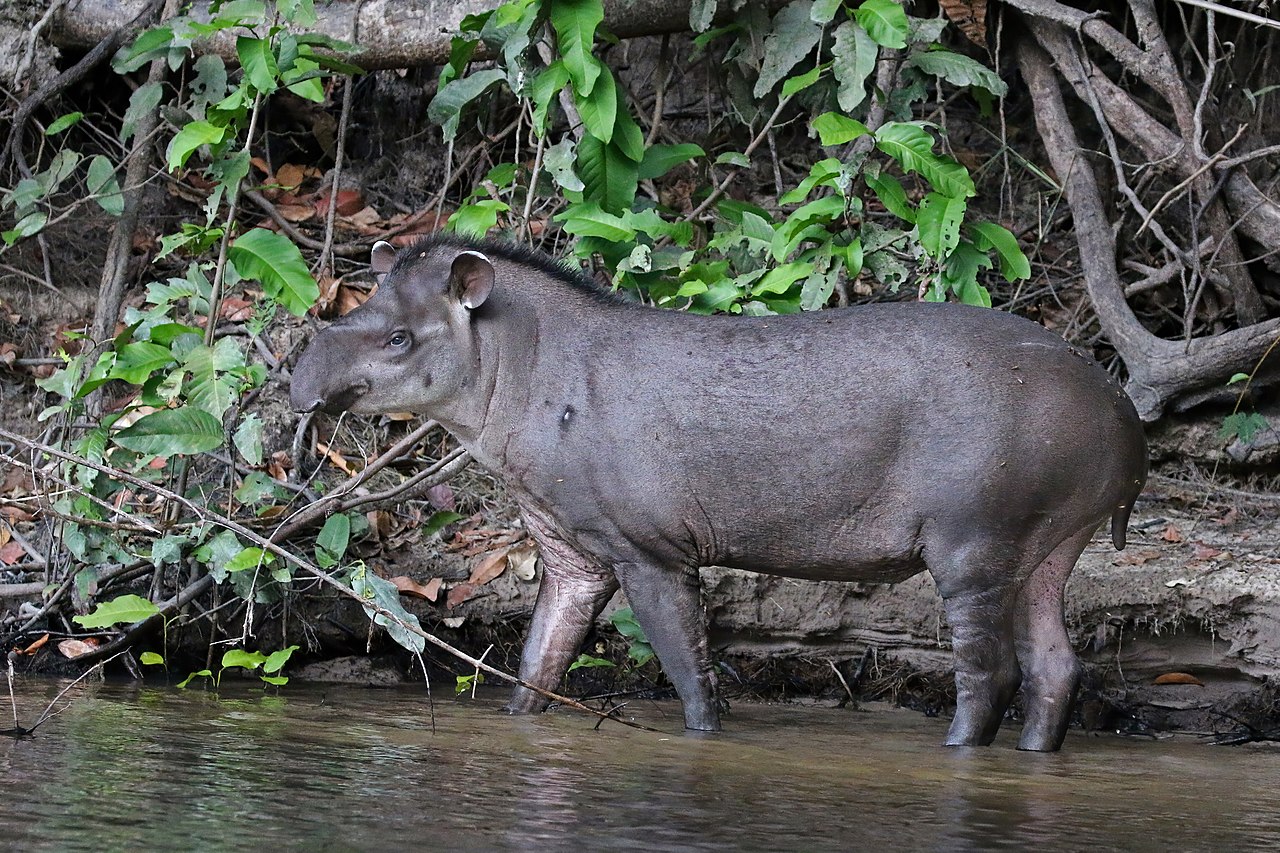
South American Tapir (Tapirus terrestris) lives in rainforest across Tropical South America. It feeds on leaves and fruits. Its conservation status is Vulnerable.
Fascinating facts about the South American Tapir
- The South American tapir is the Amazon's largest native land mammal, dwarfing every other terrestrial species in the region. Adults can grow to a body length of 1.8 to 2.5 m, and the heaviest individuals have been reported at more than 300 kg. This size advantage helps it dominate the forest floor and cross open riverbanks with confidence. Its massive build also supports a shoulder height of up to 108 cm, giving it a formidable presence in its watery habitat.
- Tapirs excel in water, swimming and diving with ease, and they can also sprint across rugged, mountainous terrain when on land. Their strong limbs and flexible bodies let them navigate steep slopes and dense undergrowth without slowing down. This dual capability allows them to escape predators by slipping into rivers or sprinting up hills, making them versatile movers in the Amazon basin.
- In the wild a South American tapir lives about 25 to 30 years, reaching sexual maturity by its third year. Females mate between April and June, endure a gestation of roughly 13 months, and typically give birth to a single calf every two years. The newborn weighs around 6.8 kg and remains dependent on its mother for about six months before weaning.
- Only the black caiman and the critically endangered Orinoco crocodile are large enough to prey on tapirs. Jaguars and cougars also hunt them at night after they leave the water and rest on riverbanks, making these predators the primary threats in their habitat.
- In 2005 a farmer stabbed a 400-lb female tapir that was feeding in his cornfield. The animal fought back, repeatedly biting the man, a rare display of aggression for such a normally shy herbivore.
Sources
Every fact above was checked against these pages, and kept only where one of them states it.
At a glance
RangeTropical South America
HabitatRainforest
DietLeaves and fruits
About the South American Tapir
In the dappled light of the South American rainforest, the tapir moves with a quiet purpose, its stout legs carrying it effortlessly through the underbrush as it searches for the tender shoots and leaves that sustain it. With a snout that twitches like a sensitive finger, it probes the forest floor, a gentle giant in a world of vibrant colors and cacophonous sounds, its very existence a reminder of the beauty and fragility of this precious ecosystem. As it disappears into the shadows, its distinctive coat blending seamlessly into the dappled landscape, we are left with a sense of awe and reverence for this elusive, vulnerable creature.
Hear the South American Tapir, and 4,400+ more
Real recorded sounds, 11 nature games and a free Daily 5, 1v1 quiz duels, conservation wins and a safe Kids mode. Free on Feravox.