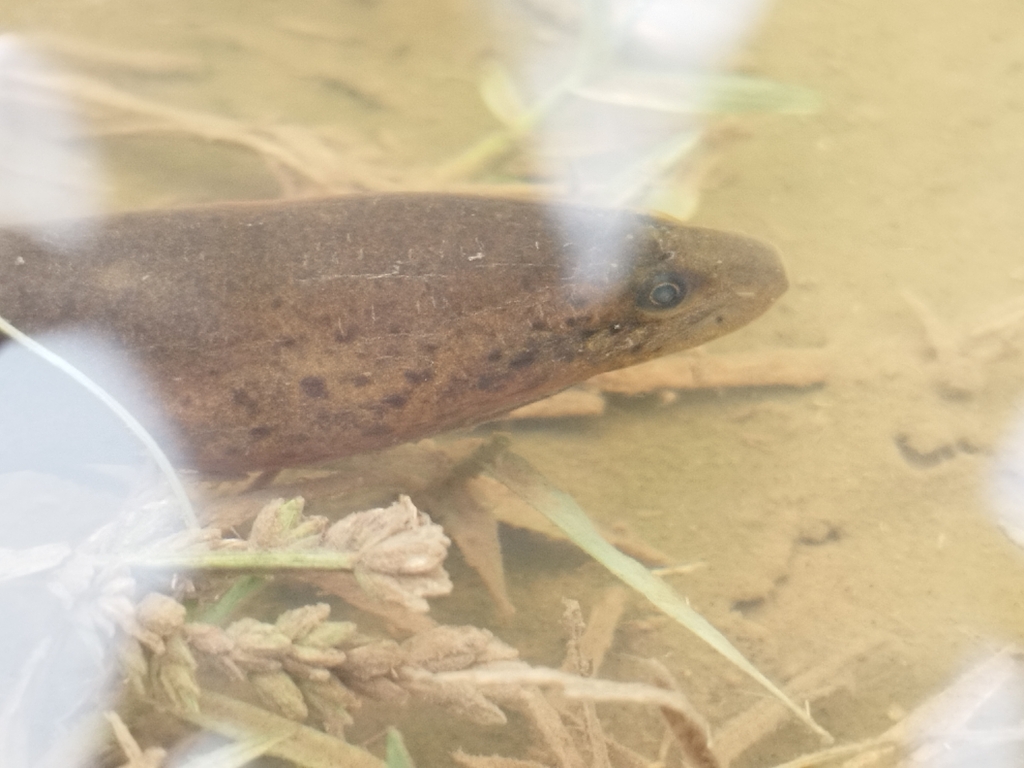
Photo: Sebastián Fornés
Feravox · The Voice of the Wild
Marbled Swamp Eel
Synbranchus marmoratus
Least Concern
Marbled Swamp Eel (Synbranchus marmoratus) lives in freshwater swamp across Central and South America. It feeds on small amphibians and invertebrates. Its conservation status is Least Concern.
The marbled swamp eel, Synbranchus marmoratus, is a sleek, elongated fish that can reach up to 150 cm (60 in) but most adults linger around 50 cm (20 in). Its cylindrical body lacks pectoral and pelvic fins, and the dorsal and anal fins are reduced to vestiges, giving it a serpentine silhouette that glides through the tangled roots and leaf litter of Central and South American waterways. Beneath its mottled, marbled skin lies a mouth lined with a richly vascularised membrane, a secondary respiratory surface that kicks in when the eel abandons the water to explore the damp earth of riverbanks. By day it burrows deep enough to stay below the water table, emerging at night to hunt; by night it becomes a voracious predator, snapping up frogs, tadpoles, fish, spiders, insects and other invertebrates with equal relish. Its nocturnal forays into shallow pools and dense vegetation are punctuated by daring descents into burrows, where it can survive months of drying conditions, sustained by the oxygen-rich lining of its mouth and pharynx. A remarkable twist in its life history is sequential hermaphroditism: juveniles may start as primary males or females, and those that become females later transform into secondary males at 45–60 cm (18–24 in), a strategy that fuels rapid colonisation of new or harsh habitats. The secondary males dig and guard nests, ensuring the next generation of these adaptable eels can continue their secretive, amphibious existence.
Real recorded sounds, 11 nature games and a free Daily 5, 1v1 quiz duels, conservation wins and a safe Kids mode. Free on Feravox.