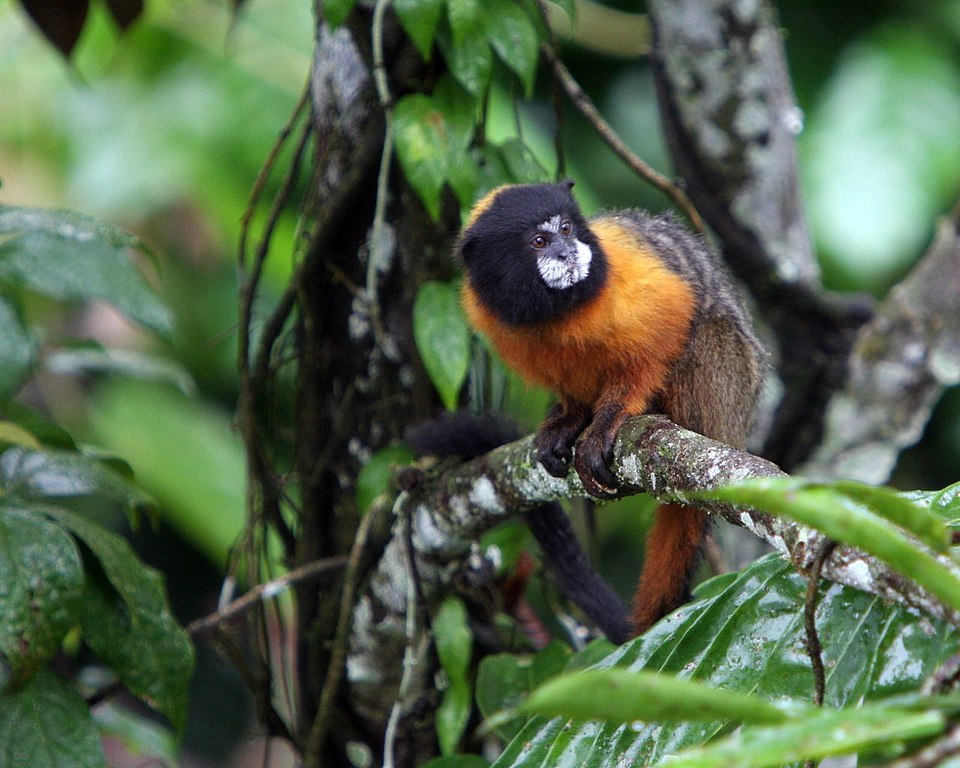
Golden-mantle Saddleback Tamarin (Saguinus tripartitus) lives in tropical rainforest across Northwestern South America. Its conservation status is Near Threatened.
Fascinating facts about the Golden-mantle Saddleback Tamarin
- The golden-mantled tamarin inhabits a narrow strip of the upper Amazon, confined to Ecuador and northeast Peru between the Rio Curaray and Rio Napo. Its range sits east of the Andes, far from major human settlements. This distribution places the species in lowland forest on the eastern side of the mountain chain, limiting its habitat to a specific riverine corridor in the upper Amazon basin.
- Adults measure just 218-240 mm from nose to the start of the tail, while the tail itself adds another 316-341 mm. This compact body and long, non-prehensile tail give the tamarin a distinctive silhouette in the canopy. The tail, although not used for grasping, aids balance as the animal moves by quadrupedal walk and leap through the understory.
- While most of its diet is fruit, nectar and insects, the tamarin also extracts gum from natural cavities and from holes that pygmy marmosets have bored in trees. This opportunistic gum-feeding links two small primate species, allowing the tamarin to exploit a resource that would otherwise be inaccessible. The behaviour occurs as the tamarin searches the understory for food between 4 - 10 m above the forest floor.
- From the moment they are born, golden-mantled tamarin twins are not left solely with their mother; other members of the small group, including males, pick them up and transport them. This alloparental carrying begins on day one and continues as the infants develop. The practice reflects the species' intense social bonds and ensures that vulnerable newborns receive constant protection and warmth while the mother forages.
- The IUCN classifies the golden-mantled tamarin as Near Threatened, projecting a decline of about 25 % over three generations, roughly 18 years, because deforestation is expected to accelerate. In 2008 the species was formally assessed for the Red List, highlighting the looming risk. Its forest habitat along the Rio Yasuni in Ecuador remains relatively untouched, with only small petroleum-prospecting encampments so far.
Sources
Every fact above was checked against these pages, and kept only where one of them states it.
At a glance
RangeNorthwestern South America
HabitatTropical rainforest
DietInsects and fruit
About the Golden-mantle Saddleback Tamarin
In the lush, vibrant tapestry of the tropical rainforest, the Golden-mantle Saddleback Tamarin dances through the trees with an air of irrepressible joy, its bright orange mantle glowing like a fleck of sunlight as it leaps from branch to branch. With each bound, its long, slender tail streams behind it, a banner of agility and grace, as it pursues its quest for fruit and insects in the forest's emerald depths. As it moves, the tamarin's large, round eyes shine with a piercing intelligence, a testament to its remarkable social nature and the complex, fascinating world it inhabits.
Hear the Golden-mantle Saddleback Tamarin, and 4,400+ more
Real recorded sounds, 11 nature games and a free Daily 5, 1v1 quiz duels, conservation wins and a safe Kids mode. Free on Feravox.