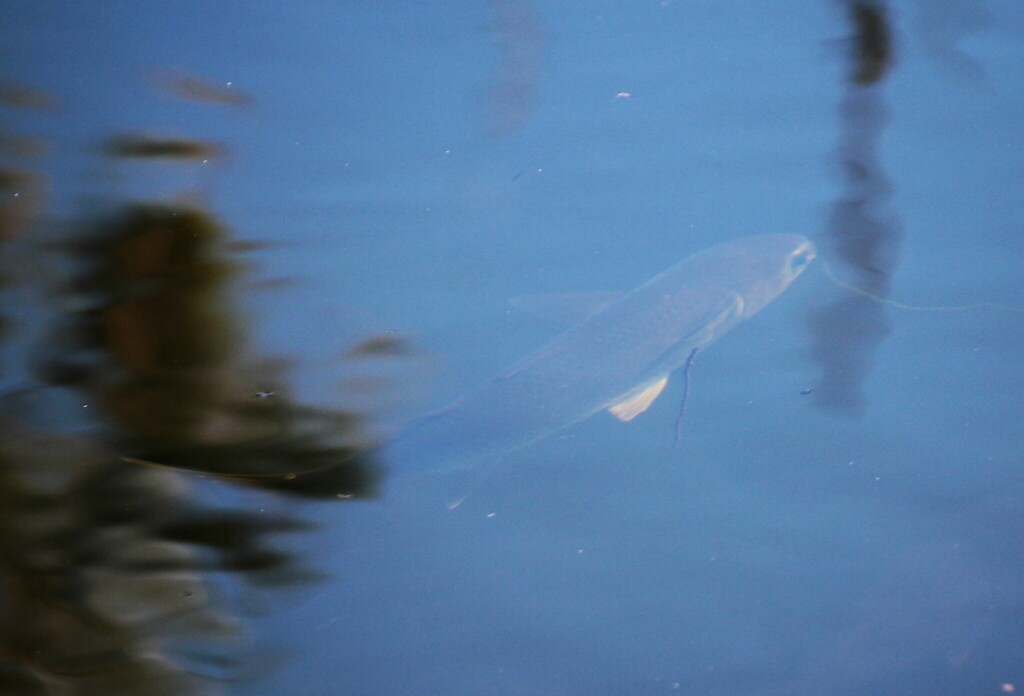
Photo: Ashwin Srinivasan
Feravox · The Voice of the Wild
Flathead Grey Mullet
Mugil cephalus
Least Concern
Flathead Grey Mullet (Mugil cephalus) lives in coastal marine, estuarine across global coastal waters. It feeds on zooplankton and detritus. Its conservation status is Least Concern.
The flathead grey mullet, Mugil cephalus, glides through coastal waters with an olive-green back that fades to silvery sides and a white belly, often marked by six or seven faint horizontal stripes. Growing most commonly to about 50 cm (20 in) but capable of reaching 100 cm (39 in) and 8 kg (18 lb), it lacks a lateral line and sports thin lips that help it scrape algae from substrates. A true euryhaline, this diurnal wanderer frequents sandy or muddy bottoms, estuaries, river mouths and even inland lagoons, tolerating salinities from fresh to marine and temperatures between 8 °C and 24 °C (46 °F–75 °F). Its diet is a cosmopolitan buffet of zooplankton, microalgae, detritus and dead plant matter, shifting to primarily algae when it ventures into fresh water, a flexibility that fuels its worldwide distribution from the Bay of Biscay to Nova Scotia, across the Indo-Pacific and down to the southern coasts of Australia. Beyond its role as a staple food fish, the mullet’s life cycle hides a surprising migratory nuance: although it can thrive far inland, it returns to the sea to spawn, a journey that links distant river systems to open ocean currents. This migratory pulse is reflected in its ontogeny, where embryonic and larval stages, meticulously described in a 2021 study, reveal developmental quirks that inform both phylogenetic debates and aquaculture practices. In 2024, global harvests topped 125,000 tonnes, with 5 % sourced from farms, underscoring how its adaptability fuels both wild fisheries and cultured production, while its roe is prized worldwide as salted delicacies such as bottarga, karasumi and avgotaraho.
Real recorded sounds, 11 nature games and a free Daily 5, 1v1 quiz duels, conservation wins and a safe Kids mode. Free on Feravox.