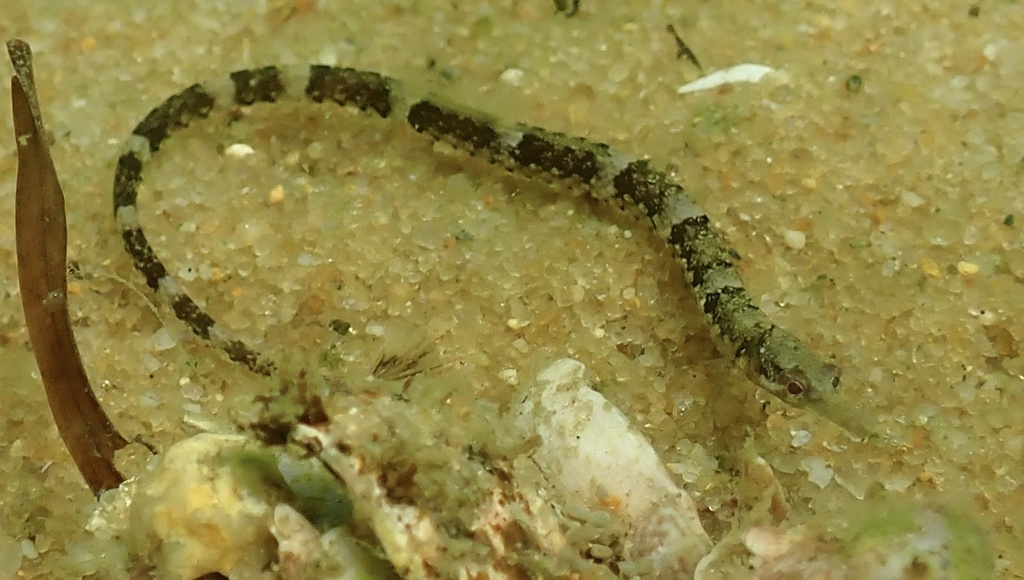
Photo: Thomas Irvine
Feravox · The Voice of the Wild
Northern Pipefish
Syngnathus fuscus
Least Concern
Northern Pipefish (Syngnathus fuscus) lives in sheltered coastal bays across Northwestern Atlantic. It feeds on zooplankton and small crustaceans. Its conservation status is Least Concern.
The northern pipefish (Syngnathus fuscus) glides through the shallow waters of the northwest Atlantic with a body that is both a marvel of engineering and camouflage. Encased in a series of bony rings, its slender form can reach up to 30 cm, though most individuals are seen between 10 and 20 cm. Its head tapers to a rounded snout, and a dorsal fin stretches over four to five of those rings, while a tiny anal fin and a rounded caudal fin complete its streamlined silhouette. Olive-brown tones mottled across its back help it blend into the seagrass and algae that line bays, tide pools, and other sheltered habitats, where breaking surf is absent and depths range from less than two meters to 366 m. In the quiet coves where it lives, the pipefish’s most striking behavior is its male brood pouch: two lateral flaps meet along the midline to cradle the fertilized eggs, a reproductive strategy shared with its seahorse cousins. Feeding is opportunistic yet focused, studies show a diet dominated by zooplankton, though the species will snatch up a variety of small aquatic organisms. Seasonal migrations have been recorded, suggesting a subtle, perhaps temperature-driven, movement between coastal nurseries and deeper foraging grounds, a trait that surprises many who think of pipefish as strictly sedentary.
Real recorded sounds, 11 nature games and a free Daily 5, 1v1 quiz duels, conservation wins and a safe Kids mode. Free on Feravox.