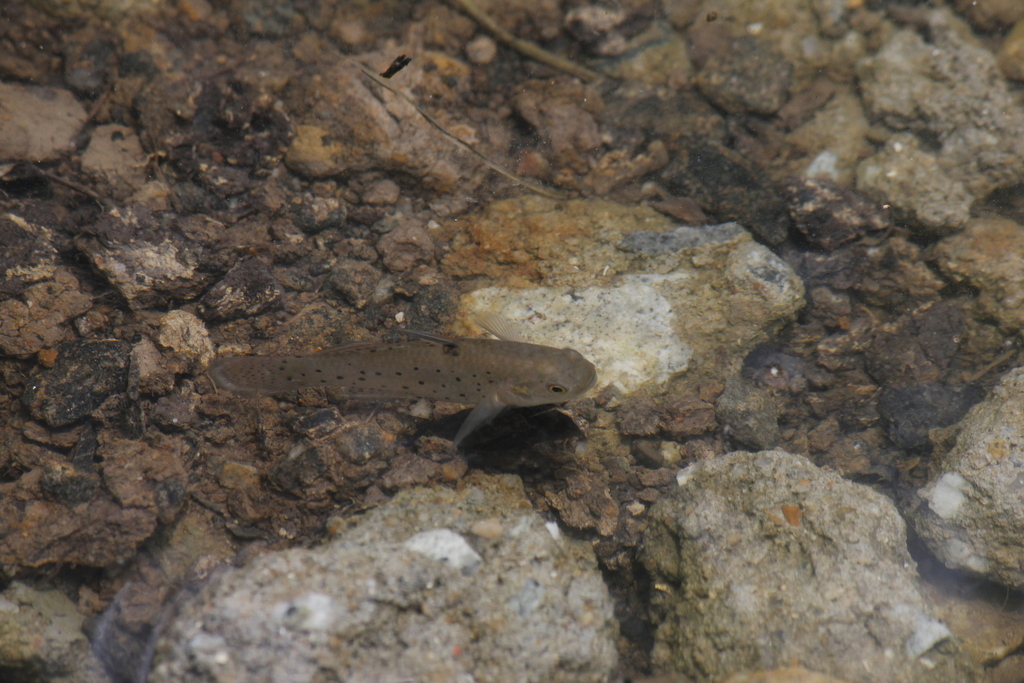
Photo: Stella Fish
Feravox · The Voice of the Wild
Spotted Goby
Stigmatogobius sadanundio
Least Concern
Spotted Goby (Stigmatogobius sadanundio) lives in freshwater estuaries across South Asia. Live and commercial foods. Its conservation status is Least Concern.
The spotted goby, Stigmatogobius sadanundio, glides through the murky estuaries and tidal rivers of South Asia, from India to Indonesia, including Sri Lanka and the Andaman Islands. Its sleek, gray-blue body is capped by two dorsal fins; the anterior fin bears about six stiff rays often marked with a black blotch, while the second dorsal mirrors the long-based anal fin in length. Dark spots pepper both fins, and the fish reaches a modest 9 centimetres (3.5 in) standard length. In the wild it favors mostly fresh waters, occasionally venturing into brackish zones, where it claims rocky crevices and submerged caves as territorial strongholds. This solitary, highly territorial creature is known to become skittish under bright light, preferring the dim, shifting currents of its natural habitat. In captivity the knight goby, its aquarium trade name, exhibits the same territorial zeal, demanding plenty of rocks and caves to define its domain. It thrives on live prey but will accept most commercial feeds, and tolerates a temperature range of 20–26 °C (68–79 °F) with a subtle nightly dip. A surprising trait emerges during breeding: the pair deposits up to a thousand eggs on the ceilings of caves, each egg anchored by a fine thread, and both parents guard the brood, allowing the fry to be raised on newly hatched brine shrimp with relative ease.
Real recorded sounds, 11 nature games and a free Daily 5, 1v1 quiz duels, conservation wins and a safe Kids mode. Free on Feravox.