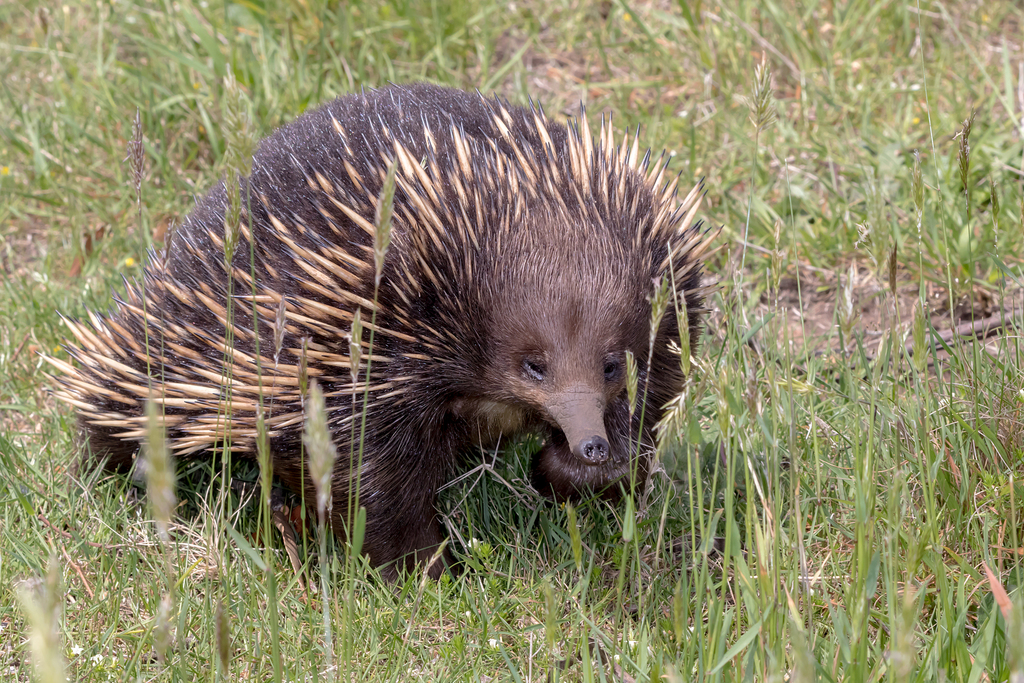
Echidna (Tachyglossus aculeatus) lives in forest, grassland, and scrub across Australia and New Guinea. It feeds on insects and worms. Its conservation status is Least Concern.
Fascinating facts about the Echidna
- Short-beaked echidnas can move a 13.5 kg (30 lb) stone. Their limbs have a mechanical advantage greater than that of humans because the biceps attaches farther down the humerus, allowing more muscle mass in the shoulder-torso region. This power lets them tear apart large logs and dig deep burrows.
- An echidna's tongue can flick in and out of its snout up to 100 times per minute, extending 180 mm (7 in) and sticking to ants with glycoprotein-rich mucus. The tongue's rapid motion is powered by elastic recoil and a burst of blood that stiffens it, letting the animal pierce wood and soil to snag insects. This speed lets a 3 kg (6.6 lb) specimen gulp 200 g (7.1 oz) of termites in just ten minutes.
- Echidnas tolerate extreme underground gases: they can survive in air with very high carbon-dioxide levels and low oxygen, and their heart rate can drop to about 12 beats per minute, one-fifth of resting rate, when diving or enduring bush-fire smoke. This bradycardia conserves oxygen for the brain and heart, mirroring seal physiology and allowing the animal to stay underground for up to a metre deep during fires.
- The echidna's brain dedicates almost half of its cortical surface to the snout and tongue, and its pre-frontal cortex occupies 50 % of total brain volume, more than the 29 % found in humans. This massive sensory and decision-making region supports its sophisticated foraging, electro-reception, and social scent communication, highlighting why such a small mammal can thrive across diverse habitats from deserts to alpine zones.
- Echidnas can live up to 50 years in captivity, almost four times longer than expected for a 2-7 kg mammal, thanks to a low basal metabolic rate and membranes rich in monounsaturated fats that resist oxidative damage. During arousal from torpor their metabolism spikes nine-fold, and free-radical production is high, linking their slow growth, single-offspring strategy, and large brain to exceptional longevity.
Sources
Every fact above was checked against these pages, and kept only where one of them states it.
At a glance
RangeAustralia and New Guinea
HabitatForest, grassland, and scrub
DietInsects and worms
About the Echidna
As the sun sets over the Australian outback, a small, enigmatic creature emerges from the underbrush, its spiny coat glistening like a thousand tiny jewels in the fading light. The echidna, a curious and solitary wanderer, moves with a slow, deliberate pace, its long snout twitching as it snuffles out the hidden delights of the desert floor. With its unique, hedgehog-like demeanor and remarkable ability to curl into an impenetrable ball of spines, this fascinating animal navigates its arid world with a quiet, unassuming confidence.
Hear the Echidna, and 4,400+ more
Real recorded sounds, 11 nature games and a free Daily 5, 1v1 quiz duels, conservation wins and a safe Kids mode. Free on Feravox.
Echidna photographed on Feravox