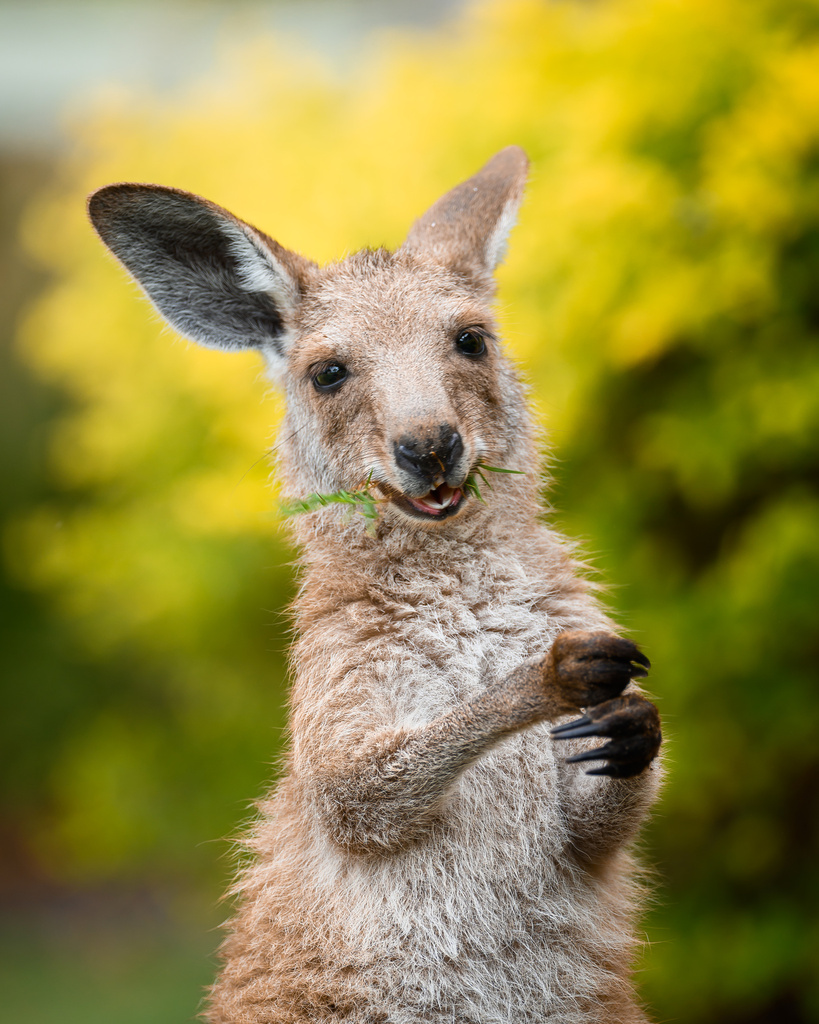
Eastern Grey Kangaroo (Macropus giganteus) lives in grassland across Australian Outback. It feeds on grass and leaves. Its conservation status is Least Concern.
Fascinating facts about the Eastern Grey Kangaroo
- A single eastern grey male can tip the scales at 69 kg and stretch over 2 m, but the true giants dwarf even that. One Tasmanian specimen tipped 82 kg and measured 2.64 m from nose to tail, while the record holder examined by Lydekker weighed a staggering 91 kg and stretched 2.92 m along its curves. Even faster, a large female once hit 64 km/h, the fastest speed ever logged for any kangaroo. These extremes show how this marsupial pushes the limits of size and sprinting power among mammals.
- Eastern greys live in loose "mobs" that average just three members, yet these tiny gatherings can swell without losing vigilance. Studies show individual alertness doesn't drop noticeably as the mob grows, meaning each kangaroo still watches for danger even in larger groups.
- Female eastern greys stay perpetually pregnant, pausing embryo development whenever a joey still occupies the pouch, a strategy called embryonic diapause. This pause kicks in during drought or poor food, letting mothers conserve resources. Meanwhile, their milk shifts composition to match each joey's stage, and astonishingly a mother can secrete two distinct milk formulas at once for a newborn and an older pouch-resident.
- In the Australian Capital Territory, roughly 122,000 eastern greys crowd a space only 2,358 km², a density among the nation's highest. To curb their impact on fragile grasslands, the ACT's annual cull this year ran from 9 June to 31 July, slaying over 3,500 individuals across 15 reserves. That tally more than doubled the 2022 count and ranks as one of the biggest kills since the program began in 2009, highlighting the tension between conservation of native flora and managing booming kangaroo numbers.
- Scientists still debate whether eastern greys split into two subspecies. While the Mammal Species of the World once listed M. g. giganteus and M. g. tasmaniensis, major bodies like the IUCN and Australian Mammal Society now reject that split. Genetic work backs the view: phylogenetic comparisons found no clear DNA differences between the mainland and Tasmanian populations, urging a taxonomic revision. This underscores how even well-known animals can hide hidden genetic unity.
Sources
Every fact above was checked against these pages, and kept only where one of them states it.
At a glance
RangeAustralian Outback
HabitatGrassland
DietGrass and leaves
About the Eastern Grey Kangaroo
Across the sun-baked expanse of the Australian outback, the Eastern Grey Kangaroo moves with effortless elegance, its powerful hind legs propelling it forward in a fluid, almost ethereal bound. As it traverses the grasslands and open woodlands, its large, dark eyes scan the horizon with a quiet intelligence, ever vigilant for the presence of predators or potential rivals. With each majestic leap, the 'roo embodies the very essence of its unfettered, wild domain, a symbol of the unbridled freedom that defines this ancient, sun-kissed land.
Hear the Eastern Grey Kangaroo, and 4,400+ more
Real recorded sounds, 11 nature games and a free Daily 5, 1v1 quiz duels, conservation wins and a safe Kids mode. Free on Feravox.