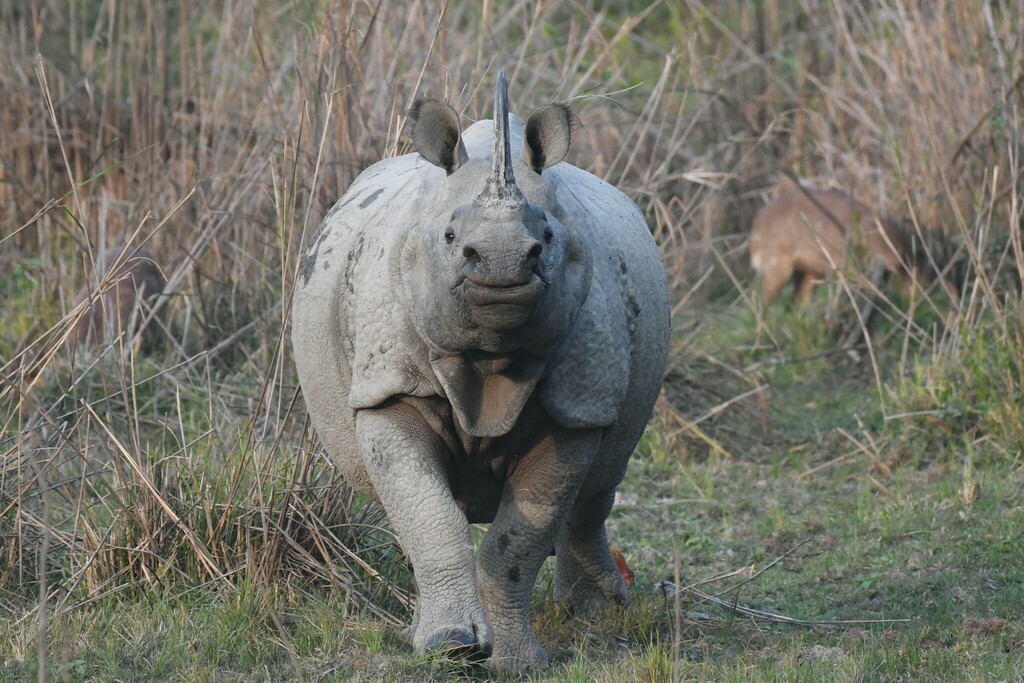
Indian Rhinoceros (Rhinoceros unicornis) lives in tropical grasslands across Northern India and Nepal. It feeds on grass and leaves. Its conservation status is Vulnerable.
Fascinating facts about the Indian Rhinoceros
- Adult Indian rhinos weigh as much as a small school bus, with males tipping the scales at 2.07-2.2 t and females at 1.6 t. Their single horn can grow up to 61.6 cm long and weigh 3.051 kg, rivaling a bowling ball. This massive size makes them the second-largest living rhino and the biggest terrestrial mammal in Asia after the elephant.
- From a low of about 1,870 individuals in the early 1990s, the Indian rhino population has more than doubled to an estimated 4,075 by March 2025. This rebound reflects conservation measures, yet the species remains vulnerable because over 70 % of the animals live in a single park, Kaziranga, making any disaster there a potential extinction-level event.
- A mother rhino stays with her calf for up to four years, and the young remain dependent for 6.5-10 years before striking out on their own. This prolonged care period, supported by a gestation of 15.7 months and birth intervals of 34-51 months, occurs in a landscape where tigers occasionally prey on the youngest.
- Indian rhinos need roughly 150-200 kg of vegetation each day, pulling grass stems with a semi-prehensile lip that bends the stalk down before biting the tip. This feeding technique lets them harvest tall reeds and even underwater grasses.
Sources
Every fact above was checked against these pages, and kept only where one of them states it.
At a glance
RangeNorthern India and Nepal
HabitatTropical grasslands
DietGrass and leaves
About the Indian Rhinoceros
In the misty dawn of the Asian grasslands, the Indian Rhinoceros emerges, a prehistoric giant, its armor-plated hide glistening with dew as it lumbers through the tall grasses with a deliberate, primeval pace. With its poor eyesight, it navigates this world through a heightened sense of smell and hearing, its sensitive lips and ears twitching with every subtle vibration in the air. As it moves, the rhinoceros leaves an indelible mark on the landscape, its massive footprints a testament to its enduring presence in this fragile, vanishing world.
Hear the Indian Rhinoceros, and 4,400+ more
Real recorded sounds, 11 nature games and a free Daily 5, 1v1 quiz duels, conservation wins and a safe Kids mode. Free on Feravox.