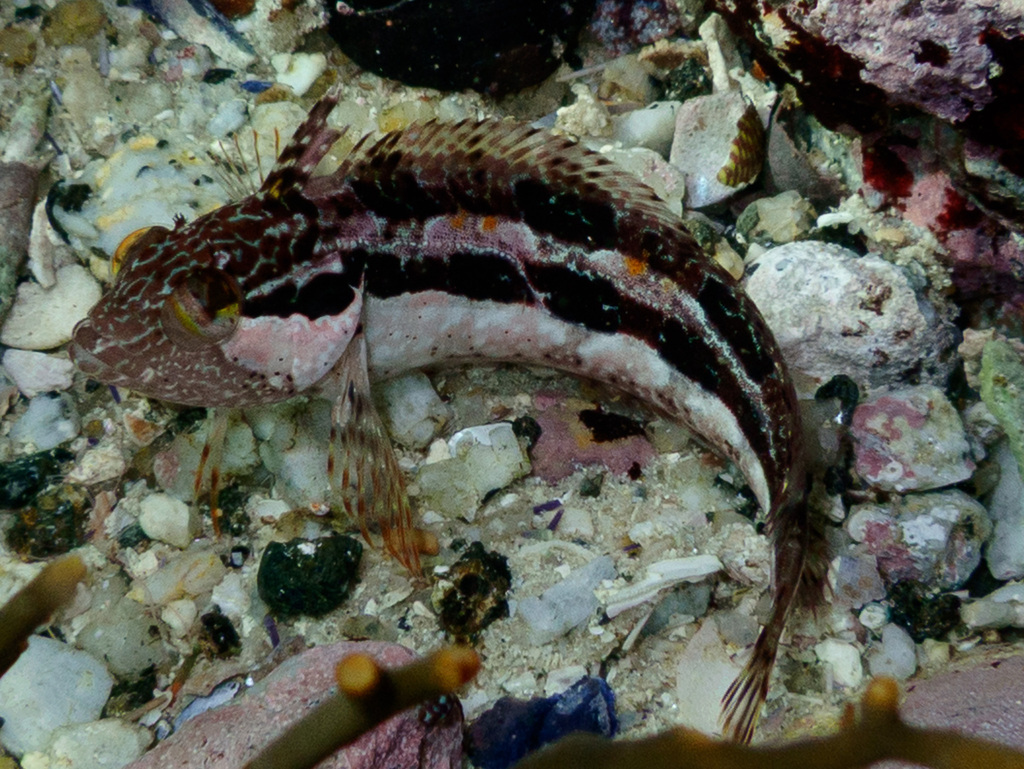
Photo: iNaturalist
Feravox · The Voice of the Wild
Autumn Klipfish
Clinus arborescens
Least Concern
Autumn Klipfish (Clinus arborescens) lives in demersal Rhodophyta beds across South Africa. It feeds on small molluscs. Its conservation status is Least Concern.
The Autumn Klipfish (Clinus arborescens) glides through the temperate Indian Ocean waters off South Africa, its slender, slightly compressed body capped by a wedge-shaped snout and an acute profile angle. A distinctive tentacle crowns each eye, while the first three dorsal spines rise into a modest crest, the notch between the third and fourth spine giving the fin a subtle serrated silhouette. Its dorsal fin bears 36–41 spines topped with fine cirri, and the pelvic fin’s inner ray is a delicate filament close to the second ray. Coloration shifts with the kelp-laden habitats it inhabits, rich browns, vivid reds, or muted greens, broken by two to four diffuse saddles and a striking light stripe that shoots from the eye, past the pectoral fin, toward the caudal peduncle. An ocellate spot perched on the opercular edge sits just above this stripe, and the eye sits slightly behind the lip margin, giving the fish a watchful, almost inquisitive look. Growing to a maximum of 22 cm (8.7 in) standard length, it lives demersally among beds of Rhodophyta, where it ambushes tiny molluscs, its slender jaws snapping shut with surprising speed. Like all clinids, the Autumn Klipfish is viviparous, giving birth to fully formed young that immediately join the intricate tapestry of algae, a surprising reproductive strategy for a fish that appears so firmly rooted in the rock-bound world of the sea floor, yet is in fact a mobile, live-bearing predator, constantly adapting to the shifting currents and seasonal blooms of its coastal realm, and
Real recorded sounds, 11 nature games and a free Daily 5, 1v1 quiz duels, conservation wins and a safe Kids mode. Free on Feravox.