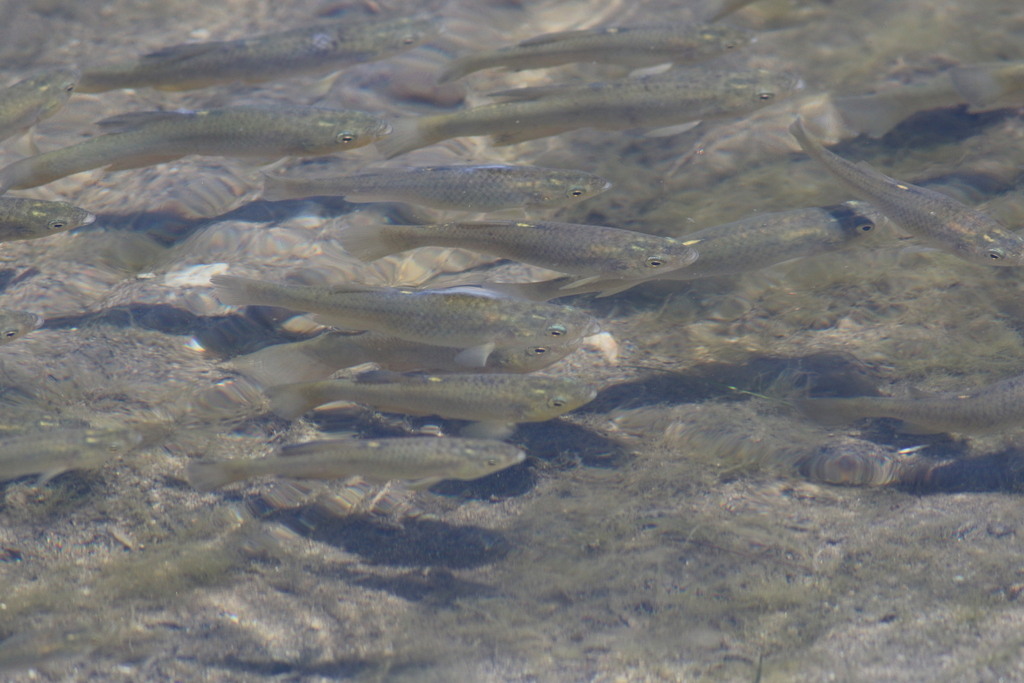
Photo: Cricket Raspet
Feravox · The Voice of the Wild
California Killifish
Fundulus parvipinnis
Least Concern
California Killifish (Fundulus parvipinnis) lives in shallow coastal estuaries across Southern California to Baja. Its conservation status is Least Concern.
The California killifish, Fundulus parvipinnis, is a compact, oblong fish that rarely exceeds 11 centimetres (4.3 in) in length. Its body is thick with a squarish tail fin and a barely narrowed caudal peduncle, giving it a sturdy silhouette. Olive-green dorsally and yellow-brown ventrally, the species undergoes a dramatic colour shift during the breeding season: the back darkens to a deep brown while the belly and paired fins blaze bright yellow, a visual cue that signals readiness to spawn. Its pelvic fins are modest, but the anal fin is long, bearing 11 to 13 rays, a feature that aids in subtle maneuvering through the tangled vegetation of its coastal homes. These killifish inhabit the shallow bays, estuaries, marshes, and lower streams that lace the coastline from Morro Bay south to Magdalena Bay in central Baja California Sur, moving almost continuously between Goleta Slough and the Tijuana River where wetlands are plentiful. Remarkably tolerant of a wide range of salinities, oxygen levels, and even pollution, they forage among high-tide-flooded vegetation, snatching benthic and planktonic invertebrates, snails, crustaceans, insects, showing an opportunistic diet that sustains them in fluctuating environments. Their ability to thrive where many fish cannot is a surprising testament to the adaptability of this western-coast Fundulus, hinting at evolutionary pathways that may one day split them into a separate genus.
Real recorded sounds, 11 nature games and a free Daily 5, 1v1 quiz duels, conservation wins and a safe Kids mode. Free on Feravox.