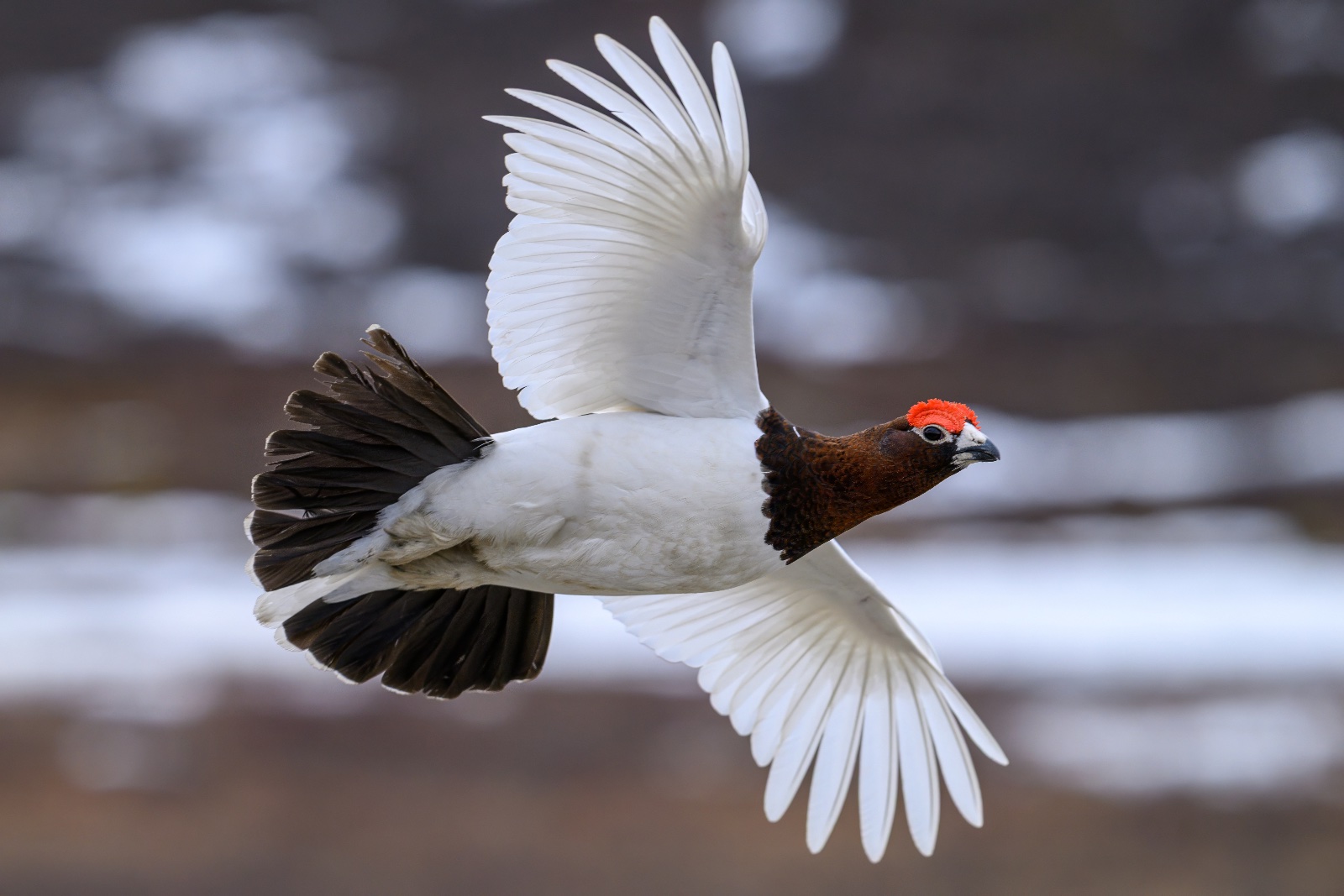
Photo: Seth Owens
Feravox · The Voice of the Wild
Willow Ptarmigan
Lagopus lagopus
Least Concern
Willow Ptarmigan (Lagopus lagopus) lives in arctic tundra across Northern Hemisphere. It feeds on berries, buds, insects. Its conservation status is Least Concern.
Every fact above was checked against these pages, and kept only where one of them states it.
Clad in a cloak of mottled gray and brown in summer, the Willow Ptarmigan (Lagopus lagopus) transforms into a ghostly white phantom when snow blankets its tundra realm, a seasonal camouflage so precise it borders on artistry. Its compact, round body, short wings, and feathered legs betray an evolutionary commitment to insulation and stealth, while its crimson eye-ring and subtle pinkish bill add a splash of color to an otherwise muted palette. The bird favors the open, windswept expanses of Arctic tundra, alpine meadows, and willow-dominated shrublands where low-lying vegetation offers both shelter and sustenance. Here, it forages on a diet of buds, leaves, and the occasional insect, shifting to a largely seed‑based menu in winter when the ground is hard‑frozen and arthropods scarce. Socially, Willow Ptarmigans are monogamous during the breeding season, performing intricate courtship displays that involve feather‑ruffling and soft, rhythmic calls that echo across the barren landscape; after nesting, the pair often remains together, defending a modest territory that can span several hectares. A surprising trait lies in their ability to lower their metabolic rate dramatically during extreme cold snaps, entering a state akin to torpor that conserves energy without the deep sleep of true hibernators, allowing them to survive nights when temperatures plunge below –40 °C, a feat that underscores their resilience. When the snow melts, these birds become nomadic explorers, trekking across vast distances in search of fresh willow shoots, their preferred winter staple. Their flight, though brief and low‑to‑ground, is surprisingly agile, enabling rapid escapes from avian predators such as Gyrfalcons and golden eagles. Yet it is their vocal repertoire that truly captivates; beyond the familiar low “kek‑kek,” males emit a resonant, low‑frequency hum that can travel over a kilometer, a sound that not only asserts dominance but also coordinates flock movements across the desolate tundra. This acoustic ingenuity, paired with their seasonal plumage shift and metabolic flexibility, paints a portrait of a species finely tuned to the extremes of its environment, ever‑present yet perpetually on the brink of vanishing into the white silence.
Real recorded sounds, 11 nature games and a free Daily 5, 1v1 quiz duels, conservation wins and a safe Kids mode. Free on Feravox.