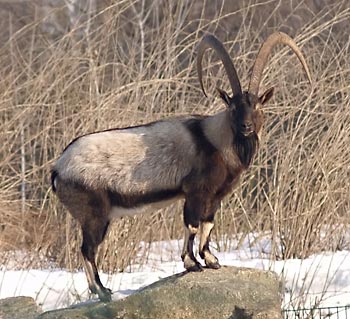
Wild Goat (Capra aegagrus) lives in mountainous rocky terrain across Southwest Asia Europe. It feeds on grasses and leaves. Its conservation status is Near Threatened.
Fascinating facts about the Wild Goat
- The wild goat is regarded as the progenitor of the domestic goat, linking the species to our farm animals. It is thought to be the ancestor of the domestic goat (C. hircus), a relationship that ties the wild populations to the familiar goat we keep for milk and meat. This ancestral link is recognised by scientists who trace the domesticated line back to the wild Capra aegagrus populations of the Caucasus and Taurus Mountains.
- In Pakistan's Kirthar National Park, herds have been recorded with as many as 131 individuals. Observations of 283 wild goat groups over ten months in 1986 showed group sizes ranging from two to 131 and a seasonal shift in composition, while maintaining a mean ratio of two females per male.
- Wild goats can live between 12 and 22 years, giving individuals the opportunity to experience several breeding cycles. The species' gestation period averages 170 days, and females reach sexual maturity at 1½-2½ years, while males mature at 3½-4 years, allowing repeated reproduction over a long lifespan. Kids are mobile almost immediately after birth and are weaned after six months, supporting the longevity of the population.
- The wild goat was first given the scientific name Capra aegagrus by Johann Christian Polycarp Erxleben in 1777, based on populations he studied in the Caucasus and Taurus Mountains. A second name, Capra blythi, appeared in 1874 when Allan Octavian Hume described horn specimens from Sindh. Both names refer to the same species, which today is recognised as having several subspecies such as the Bezoar ibex (C. aegagrus) and the Sindh ibex (C.
- The wild goat occupies a broad swathe of western Asia, extending from Turkey and the Caucasus in the west to Iran, Turkmenistan, Afghanistan and Pakistan in the east. Within Turkey it inhabits the Aegean, Mediterranean, Black Sea, southeastern and Eastern Anatolia regions, climbing to 3 250 m in the Taurus and Anti-Taurus ranges.
Sources
Every fact above was checked against these pages, and kept only where one of them states it.
At a glance
RangeSouthwest Asia Europe
HabitatMountainous rocky terrain
DietGrasses and leaves
About the Wild Goat
Across the rugged, windswept mountainsides, the wild goat moves with effortless agility, its sure-footed hooves barely touching the ground as it navigates precipitous paths with a quiet confidence. With its shaggy coat and curved horns, this resilient creature embodies the unforgiving yet majestic landscape it inhabits, its very presence a testament to the enduring power of wildness. As it climbs, the wild goat's gentle eyes seem to hold a deep understanding of the harsh, beautiful world it calls home.
Hear the Wild Goat, and 4,400+ more
Real recorded sounds, 11 nature games and a free Daily 5, 1v1 quiz duels, conservation wins and a safe Kids mode. Free on Feravox.