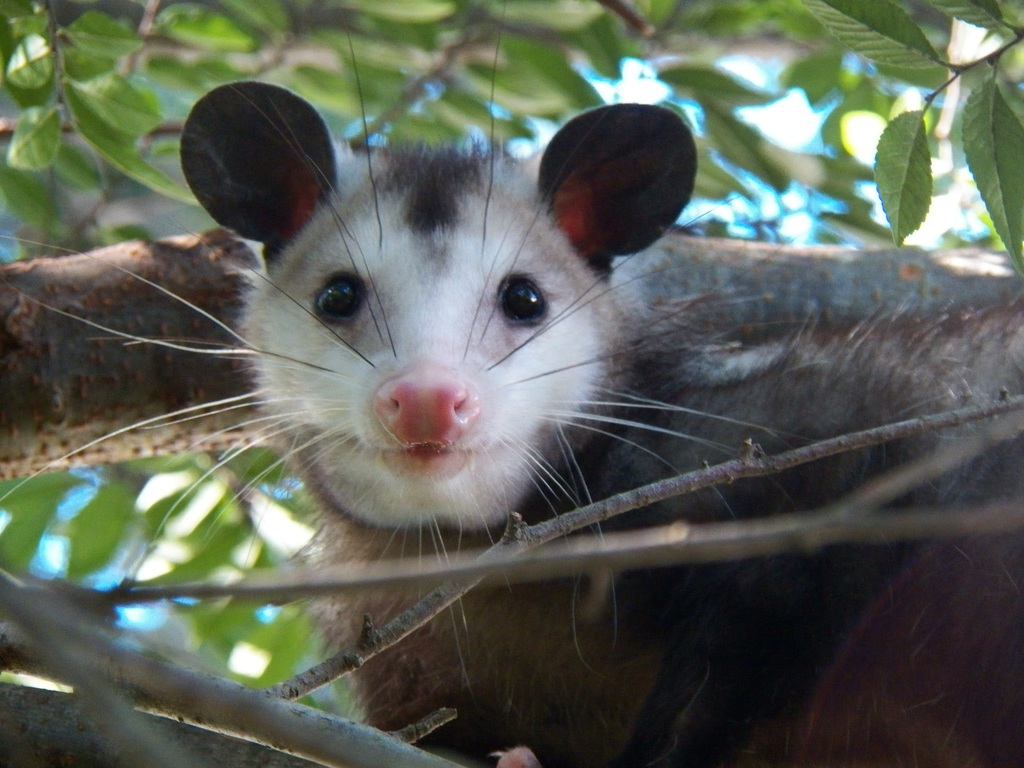
Virginia Opossum (Didelphis virginiana) lives in eastern deciduous forests across North America. It feeds on insects & fruit. Its conservation status is Least Concern.
Fascinating facts about the Virginia Opossum
- About 3 million years ago, after the Isthmus of Panama formed, the opossum's ancestors crossed into North America, but Didelphis didn't arrive until about 0.8 million years ago. Since 1900 the species has surged north, now filling most of New England, southern Ontario and even parts of Minnesota and Nebraska. In the 1960s places like Rhode Island and Waterloo Region saw almost no opossums, yet today they are common, a shift many link to milder winters from global warming.
- Male Virginia opossums average 40.8 cm in body length with a 29.4 cm tail and weigh 2.1-2.8 kg, while females are just a shade shorter and weigh 1.9-2.1 kg. Their mouths house 50 teeth, the most of any North American land mammal, and their dental formula (5.1.3.4 / 4.1.3.4) gives them ten upper incisors, more than any other North American species.
- When cornered, an opossum first bares its 50 teeth, hisses and may stand its fur on end, but if that fails it plays dead, a catatonic "playing possum" act. The animal lies limp on its side, mouth and eyes open, tongue hanging out, feet clenched, while its heart rate drops by half and breathing becomes barely detectable. This feigned death can linger for several hours, deterring predators that prefer live prey and protecting the opossum's young from attack.
- In the wild a Virginia opossum usually lives only about two years, and even in captivity most reach just four. On Georgia's predator-free Sapelo Island, however, researchers found individuals living up to 50 % longer than mainland counterparts, showing how the absence of natural enemies can extend their already brief lives. This rapid senescence reflects the species' low investment in long-term defenses.
- Gestation in Virginia opossums lasts just 11-13 days, after which a litter of 8-9 tiny newborns, each the size of a honeybee, is born, though occasionally more than 20 emerge. The babies scramble into the mother's pouch and cling to one of her 13 teats for about two months. Only one in ten offspring survive to adulthood.
Sources
Every fact above was checked against these pages, and kept only where one of them states it.
At a glance
RangeNorth America
HabitatEastern deciduous forests
DietInsects & fruit
About the Virginia Opossum
In the shadowy recesses of North America's forests, the Virginia opossum navigates its domain with an air of unhurried nonchalance, its prehensile tail grasping branches as it ambles through the underbrush with a gentle, almost ethereal, gait. As it moves, the soft rustle of leaves and snapping of twigs betray its presence, a subtle reminder of the opossum's remarkable adaptability, which has allowed it to thrive in a wide range of environments. With its pointed snout and beady eyes, this enigmatic creature embodies a quiet resilience, its very existence a testament to the enduring power of nature's most unassuming creations.
Hear the Virginia Opossum, and 4,400+ more
Real recorded sounds, 11 nature games and a free Daily 5, 1v1 quiz duels, conservation wins and a safe Kids mode. Free on Feravox.