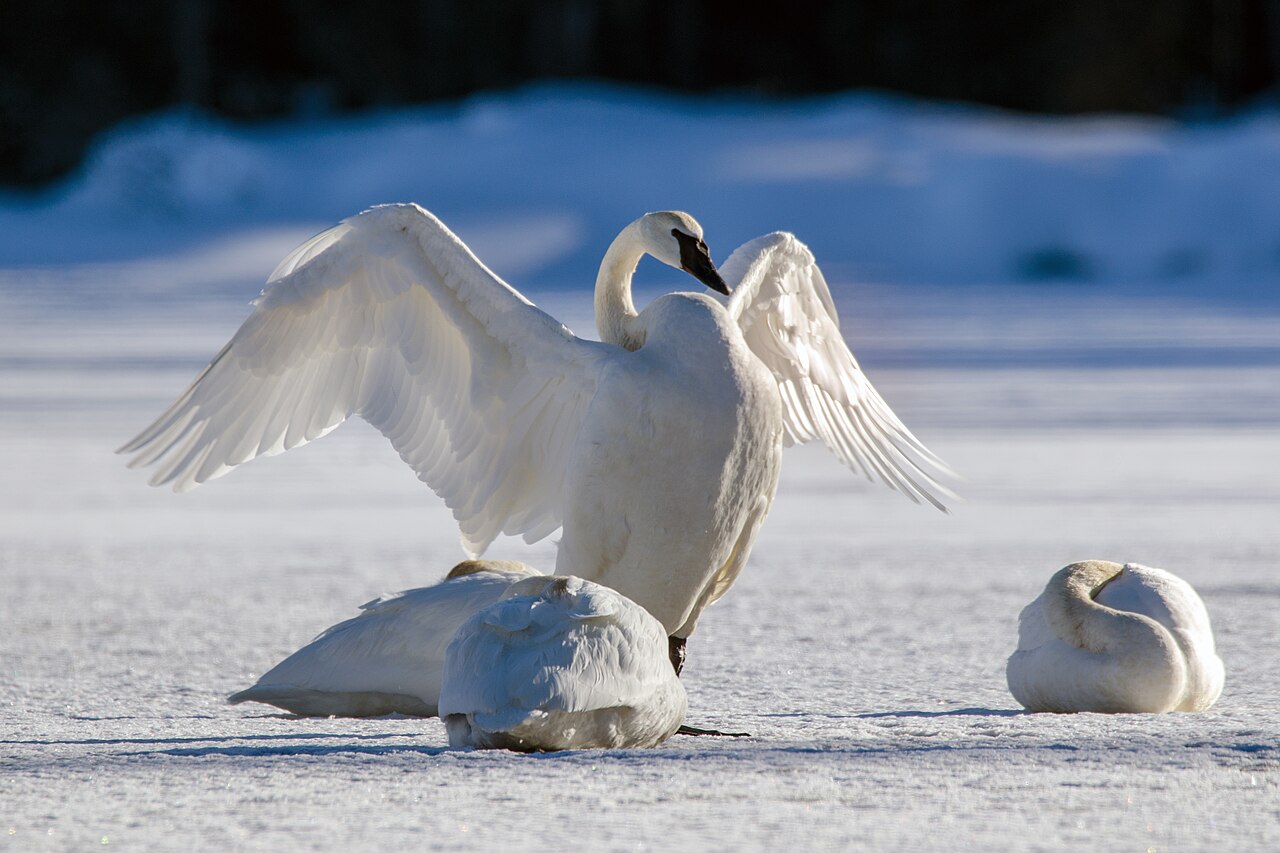
Trumpeter Swan (Cygnus buccinator) lives in wetland areas across North America. It feeds on aquatic plants grains. Its conservation status is Least Concern.
Fascinating facts about the Trumpeter Swan
- Their wings stretch from 185 cm to a massive 304.8 cm, while the biggest recorded male measured 183 cm long, boasted a 3.1 m wingspan and tipped the scales at 17.2 kg. Even average adults weigh 7-13.6 kg and measure 138-165 cm, making them the heaviest flying birds in North America.
- From the brink of extinction, trumpeter swans have rebounded to a thriving population. In 1933 fewer than 70 wild birds were known, yet aerial surveys later uncovered several thousand individuals along Alaska's Copper River. Coordinated re-introductions lifted the North American count to over 46,000 by 2010, and surveys show growth from 3,722 birds in 1968 to about 46,225 in 2010. This comeback illustrates how targeted conservation can rescue a species once thought lost.
- Trumpeter swan eggs are the largest of any flying bird alive today. A typical egg measures 113.5 mm long, 73 mm wide and weighs about 320 g, but some reach 126 mm in length and 81 mm in width. These dimensions are roughly 20 % larger than an Andean condor's eggs and more than twice the mass of a kori bustard's.
- Building a trumpeter swan nest is a marathon of engineering. The pair spends 11 to 35 days constructing a platform 1.2-3.6 m across, using submerged vegetation, grasses and sedges. Both parents haul material, but the male does most of the heavy lifting, tossing bundles over his shoulder before the pair assembles them together. Such massive, water-surrounded nests protect eggs from many predators and give cygnets immediate access to feeding grounds once they hatch.
- Trumpeter swans can live for decades, outlasting most waterfowl. In captivity the longest-recorded individual reached 33 years, while wild birds have been documented living at least 24 years. Such longevity, combined with high adult survival rates of 80-100 % annually, means that once a pair establishes a territory, it can contribute to the population for many breeding seasons, reinforcing the species' recent recovery.
Sources
Every fact above was checked against these pages, and kept only where one of them states it.
At a glance
RangeNorth America
HabitatWetland areas
DietAquatic plants grains
About the Trumpeter Swan
As the misty dawn breaks over the tranquil wetlands, the Trumpeter Swan emerges, its snowy plumage glistening like freshly fallen snow, its majestic form undulating across the water with a serene elegance. With each powerful stroke of its wings, the swan propels itself forward, its trumpeting call echoing through the landscape, a haunting melody that resonates deep within the soul. In this peaceful realm, the Trumpeter Swan reigns supreme, its graceful movements and haunting voice a testament to the enduring beauty of the natural world.
Hear the Trumpeter Swan, and 4,400+ more
Real recorded sounds, 11 nature games and a free Daily 5, 1v1 quiz duels, conservation wins and a safe Kids mode. Free on Feravox.