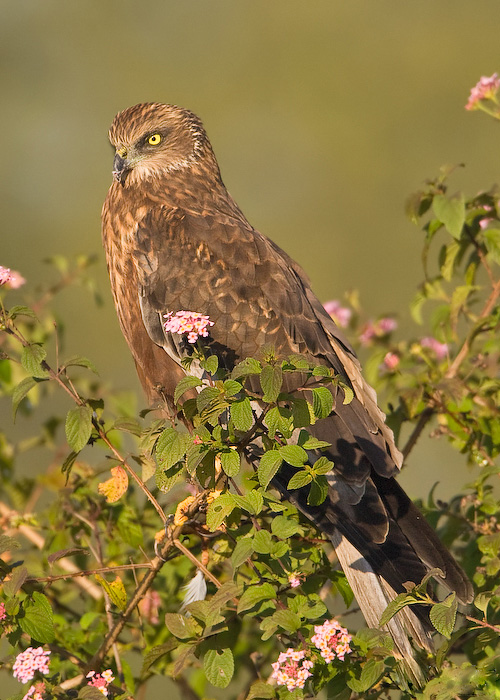
Western Marsh Harrier (Circus aeruginosus) lives in wetland areas across Europe, Africa, Asia. It feeds on small mammals birds. Its conservation status is Least Concern.
Hear the Western Marsh Harrier
A real field recording of the Western Marsh Harrier, made in the wild.
The breeding calendar of the western marsh harrier kicks off between mid-March and early May, when males may court up to three females. Nests hold three to eight speckled eggs, which the parents incubate for 31-38 days before the chicks leave the nest after another 30-40 days.
Western marsh harriers are true world-travellers: a lone bird was photographed on 4 December 1994 in Virginia, marking the first (though unconfirmed) sighting in the Americas. Confirmed visits followed in Guadeloupe during the winter of 2002/2003, Puerto Rico in early 2004 and again in January/February 2006, and finally Bermuda in December 2015.
Once thought extinct in Britain by the late 1800s, the western marsh harrier staged a dramatic comeback: after a solitary pair nested in Norfolk in 1911, surveys by 2006 recorded at least 265 females raising 453 fledglings. A similar revival occurred in Ireland, where the bird vanished in 1918.
In India's Keoladeo National Park, up to a hundred western marsh harriers gather each November-December, roosting together in tall grass or on floating water-hyacinth mats when the ground is disturbed. This massive nightly congregation likely serves as an early-warning system: predators rustle the vegetation, alerting the birds to danger. Such social roosting demonstrates the species' flexible use of habitat and its reliance on collective vigilance.
At just under a half-meter long, the western marsh harrier, making it the biggest of Europe's harriers. Its length of 48 to 56 cm, wingspan of 115 to 130 cm, and weight of 400-650 g in males and 550-800 g in females.
Sources
Every fact above was checked against these pages, and kept only where one of them states it.
As the Western Marsh Harrier soars over the wetlands, its broad wings beating in a slow, deliberate rhythm, it embodies a masterful blend of stealth and agility, its piercing gaze scanning the reeds below for the slightest hint of movement. With a fluid, effortless glide, it navigates the intricate network of waterways and vegetation, its tawny-brown plumage merging seamlessly with the surrounding landscape. In this serene and mystical world, the Marsh Harrier reigns supreme, a ghostly hunter drifting silently through the mist-shrouded dawn, its very presence a testament to the enduring beauty of the wild.
Advertisement
Hear the Western Marsh Harrier, and 4,400+ more
Real recorded sounds, 11 nature games and a free Daily 5, 1v1 quiz duels, conservation wins and a safe Kids mode. Free on Feravox.