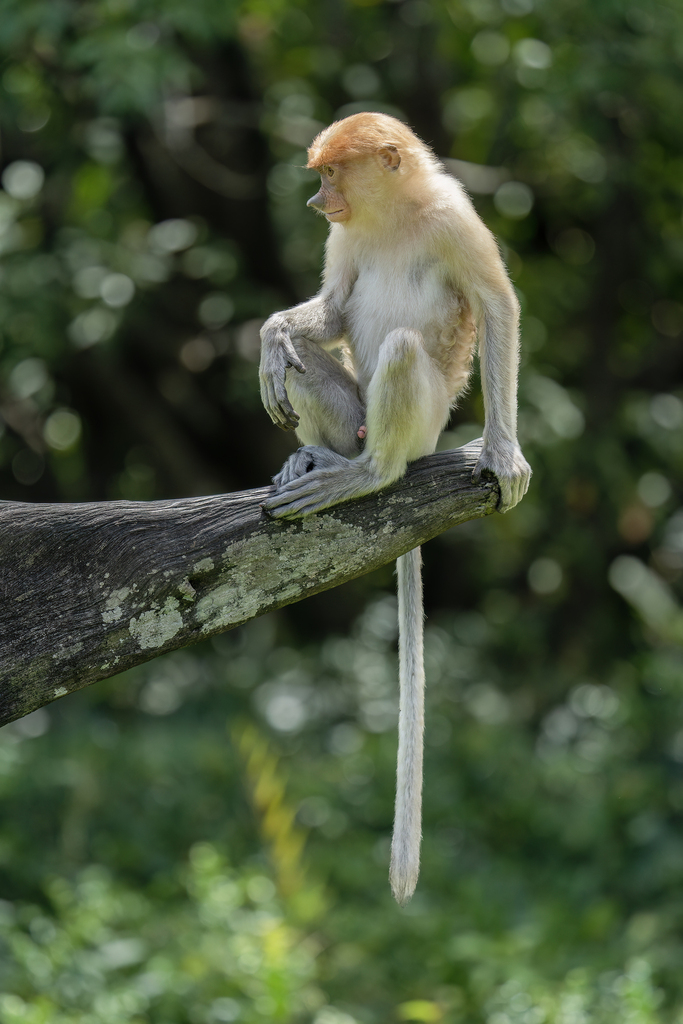
Proboscis Monkey (Nasalis larvatus) lives in mangrove and riverine forest across Borneo. It feeds on leaves and fruits. Its conservation status is Endangered.
Fascinating facts about the Proboscis Monkey
- Male proboscis monkeys sport noses longer than a ruler, over 10.2 cm (4 in) in length. The oversized proboscis likely boosts vocal resonance, letting males produce louder honks that females prefer during mate choice. This sexual-selection driven trait turns a simple nose into a powerful acoustic billboard, revealing how female preference can sculpt extreme male ornaments.
- Proboscis monkeys are the aquatic ace of the primate world, capable of swimming up to 20 m (66 ft) underwater. This ability lets them cross rivers. Their webbed toes and comfort in water expand their habitat to tidal zones, showing that swimming is a key survival tool for a species tied to Borneo's riverine forests.
- The proboscis monkey's numbers have slumped by more than half in just the last 36-40 years, dropping over 50 % by 2008. This steep decline earned it an Endangered rating on the IUCN Red List and placement in CITES Appendix I, highlighting how rapid habitat loss and hunting are pushing the species toward the brink.
- Proboscis monkeys live in tight one-male groups of 3 to 19 members, but when several groups merge they form massive bands of up to 60 individuals. These fluid gatherings allow them to share sleeping sites and coordinate river crossings while keeping aggression low, illustrating a flexible social system that balances intimate family units with the safety of large numbers.
- Female proboscis monkeys become sexually mature at about five years old and carry their single offspring for 166-200 days before giving birth, usually at night or early morning. After delivery the mother eats the placenta and nurses the infant until about seven months, after which the youngster weans at seven months.
Sources
Every fact above was checked against these pages, and kept only where one of them states it.
At a glance
RangeBorneo
HabitatMangrove and riverine forest
DietLeaves and fruits
About the Proboscis Monkey
In the lush mangrove forests of Borneo, the proboscis monkey navigates its domain with a unique blend of elegance and clumsiness, its oversized nose leading the way as it crashes through the underbrush with a rustling of leaves and snapping of twigs. As it moves through the trees, its long, muscular arms propel it with a fluid grace, a testament to its remarkable adaptability in this fragile, endangered world. The proboscis monkey's very existence is a poignant reminder of the beauty and vulnerability of life in the wild, its fate inextricably linked to the preservation of its dwindling habitat.
Hear the Proboscis Monkey, and 4,400+ more
Real recorded sounds, 11 nature games and a free Daily 5, 1v1 quiz duels, conservation wins and a safe Kids mode. Free on Feravox.