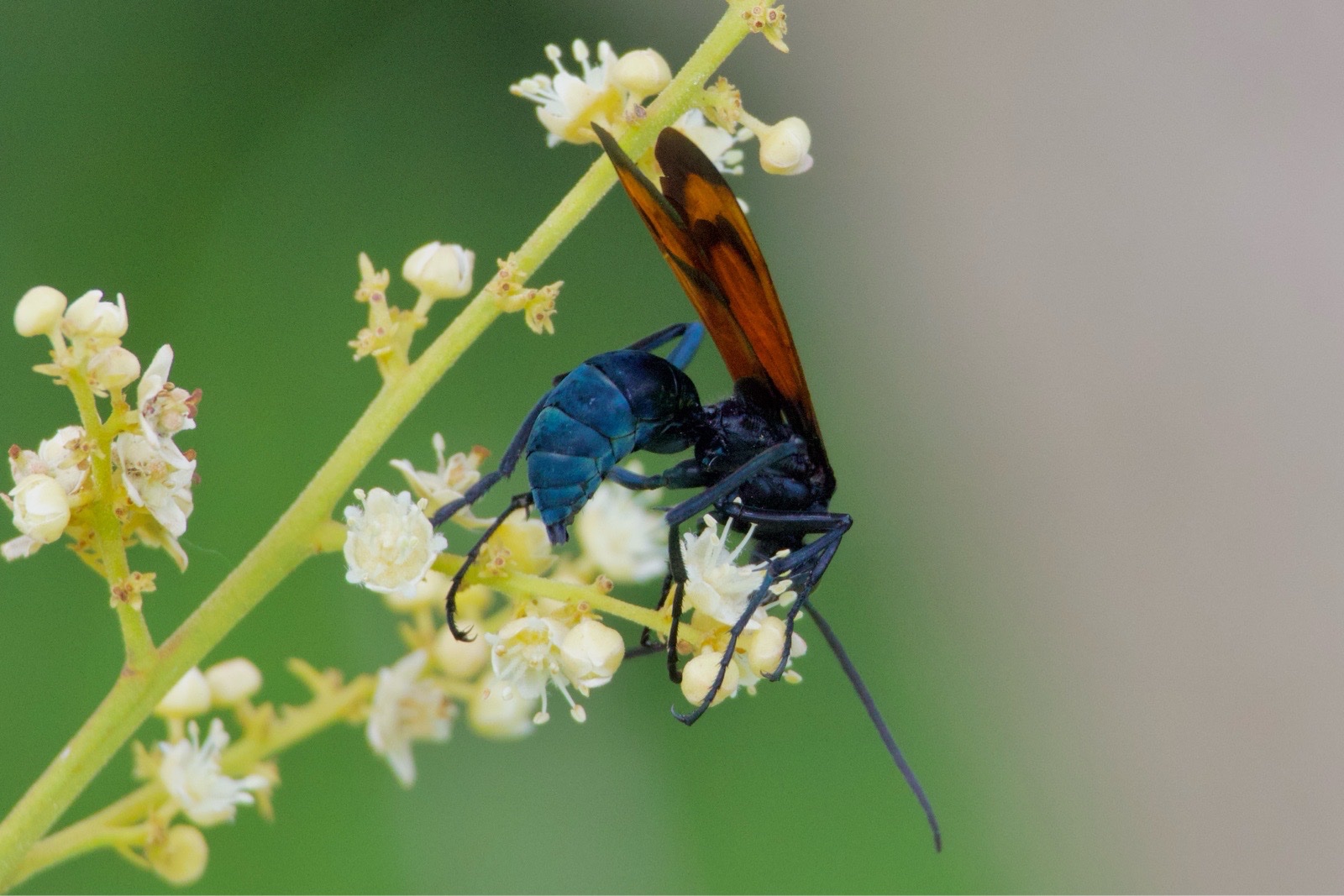
Photo: Feravox creator
Feravox · The Voice of the Wild
Pepsis marginata
Pepsis marginata
Least Concern
Pepsis marginata (Pepsis marginata) lives in arid desert across Southwestern USA, Mexico. It feeds on spiders and nectar. Its conservation status is Least Concern.
Every fact above was checked against these pages, and kept only where one of them states it.
The tarantula‑hunting wasp Pepsis marginata is a strikingly bold insect, its glossy black body streaked with vivid orange‑red bands that wrap around the slender waist and flare onto the forewings, creating a wasp that looks as if it were painted by a sunrise. Adults measure 4–5 cm in length, with long, club‑shaped antennae and a powerful stinger that glints like a tiny dagger. They inhabit the arid scrublands and open pine‑oak forests of the highlands of Mexico and Central America, where rocky outcrops and sparse vegetation provide perches for spotting prey. When a female spots a wandering tarantula, she launches a high‑speed pursuit, delivering a precise, paralyzing sting before dragging the immobilized spider back to a pre‑dug burrow to provision a single egg‑laden cell. The larva feeds exclusively on the still‑living spider, a gruesome yet efficient strategy that ensures fresh protein for development. Pepsis marginata is not merely a solitary predator; it participates in a seasonal dance of color that rivals any tropical bird. Males patrol flower patches, sipping nectar from bright yellow thistles while flashing their bright bands to signal fitness to potential mates. A surprising trait lies in their thermoregulation: they can actively pump hemolymph to their abdomen’s thin membrane, evaporatively cooling themselves during the midday heat, allowing them to remain active when many insects seek shade. This physiological adaptation, coupled with their fearsome hunting prowess, makes them a keystone player in controlling tarantula populations, subtly shaping the invertebrate community structure of their rugged habitats.
Real recorded sounds, 11 nature games and a free Daily 5, 1v1 quiz duels, conservation wins and a safe Kids mode. Free on Feravox.