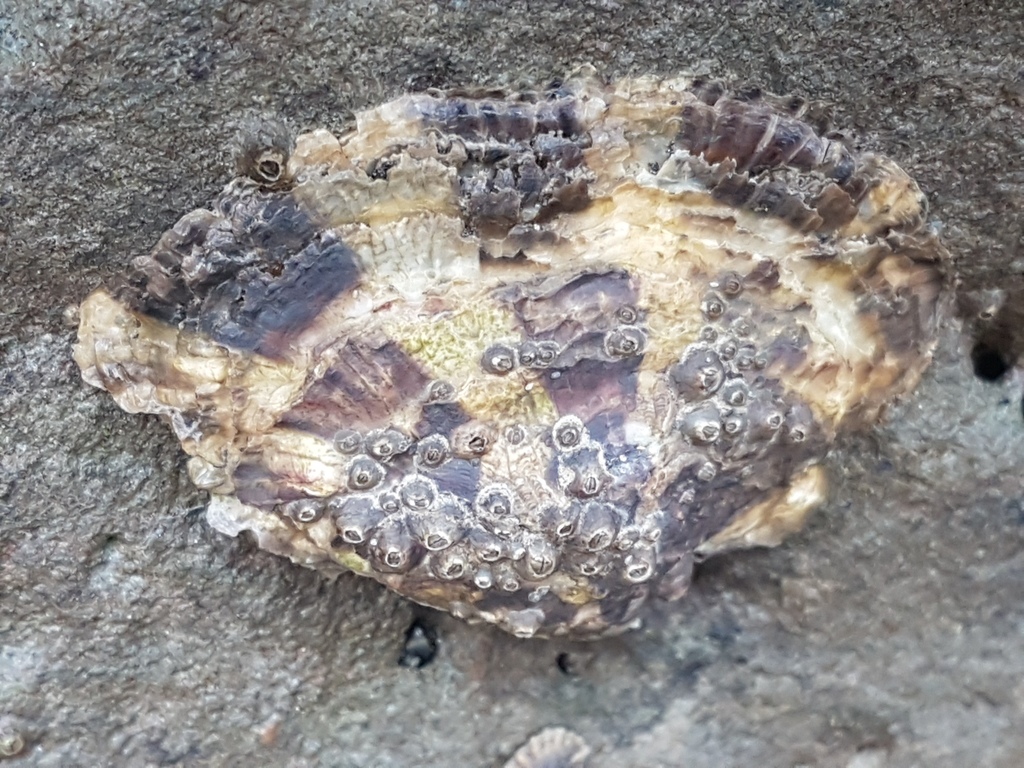
Pacific Oyster (Magallana gigas) lives in brackish coastal waters across Western coast of North America, Europe, and Asia.
Fascinating facts about the Pacific Oyster
- Mature Pacific oysters can grow from a tiny 80 mm shell up to a hefty 400 mm, yet they still cling to rocks, shells or even mud in waters no deeper than 40 m. They thrive in salty seas between 20 ppt and 35 ppt, and can survive a salinity spike to 38 ppt, though they won't reproduce then. Their temperature tolerance is equally extreme, enduring waters as cold as −1.8 °C and as warm as 35 °C.
- When water warms to 68 °F, a Pacific oyster can unleash a reproductive storm: a single female releases between 50 million and 200 million eggs, shooting them out at a frantic 5 to 10 eggs per minute. This massive output, paired with the fact that males release sperm simultaneously, creates dense clouds of gametes that drift through the water.
- Pacific oyster larvae start life at just 70 µm, drifting for weeks before cementing themselves to a surface and growing at break-neck speed. In ideal conditions they reach market size, 70 to 100 g live weight, in only 18 to 30 months, yet if left untouched they can live up to three decades.
- By the year 2000, Pacific oysters supplied 98 % of the world's cultivated oyster harvest, dwarfing all other species. Global production surged from roughly 150 000 tonnes in 1950 to 1.2 million tonnes by 1990, then leapt to 4.38 million tonnes in 2003-84 % of which came from China. This dominance translates to a 2003 market value of $3.69 billion, underscoring the species' economic powerhouse status.
- Human ships have turned the Pacific oyster into a global hitch-hiker. Intentional releases landed it on the U.S. Pacific coast in the 1920s and in France in 1966, while accidental ballast-water trips spread it further. In places like Puget Sound, New Zealand's North Island, and the Wadden Sea, it outcompetes native oysters and mussels, reshaping local ecosystems and prompting biosecurity agencies to label it an invasive threat.
Sources
Every fact above was checked against these pages, and kept only where one of them states it.
At a glance
RangeWestern coast of North America, Europe, and Asia
HabitatBrackish coastal waters
DietPhytoplankton & detritus
About the Pacific Oyster
In the tumultuous realm of the tidal zone, the Pacific Oyster clings tenaciously to the rocky substrate, its shell a masterful amalgam of strength and flexibility. As the waves ebb and flow, the oyster's delicate gills wave gently, filtering the turbulent water for the plankton and detritus that sustain it, a testament to the remarkable adaptability of this most ancient of creatures. With each successive tide, the oyster grows, its calcified shell a incremental chronicle of the seasons, a slow and patient builder of the very foundation of the marine ecosystem.
Hear the Pacific Oyster, and 4,400+ more
Real recorded sounds, 11 nature games and a free Daily 5, 1v1 quiz duels, conservation wins and a safe Kids mode. Free on Feravox.
More ocean life to discover