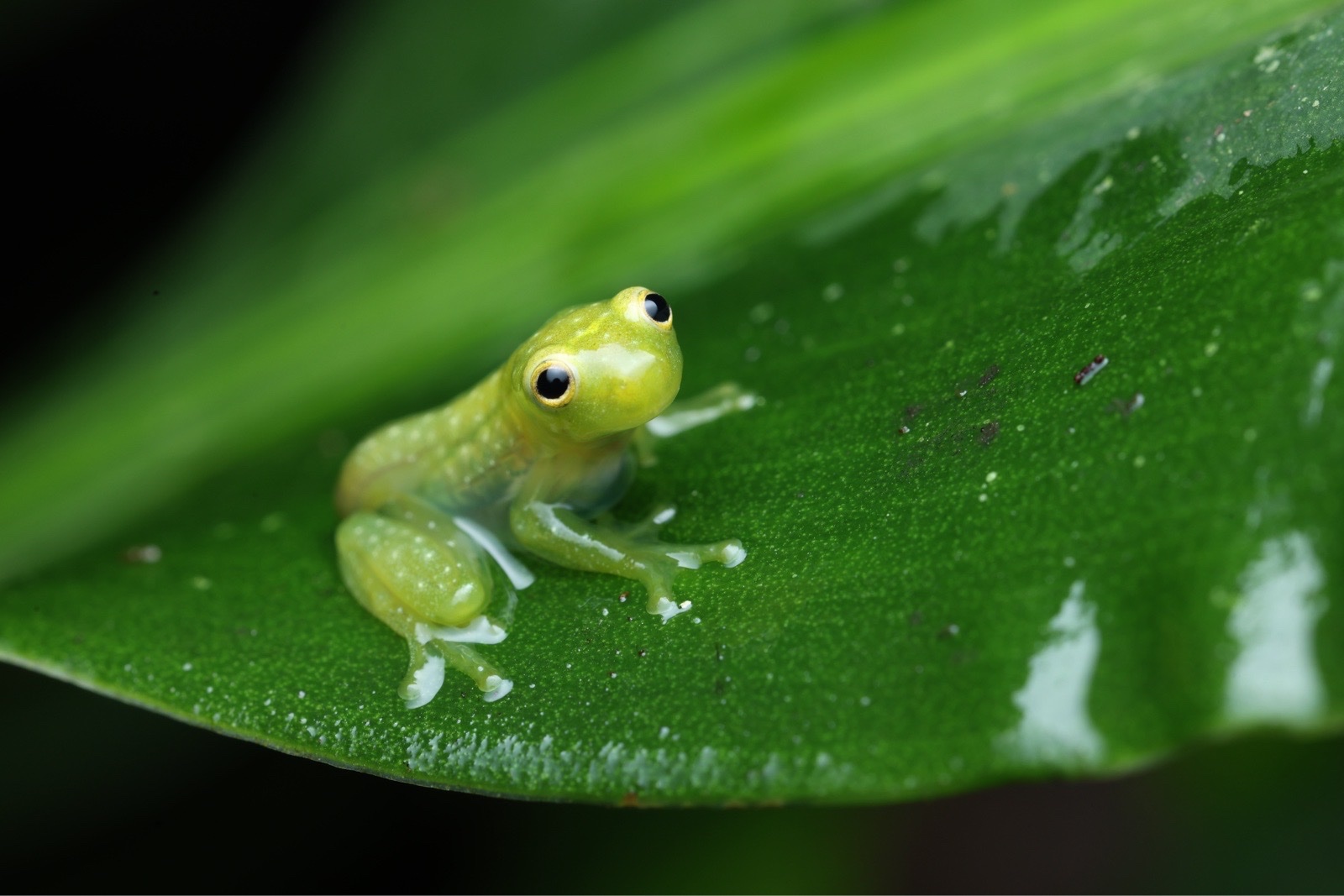
Photo: Feravox creator
Feravox · The Voice of the Wild
Nicaragua Giant Glass Frog
Espadarana prosoblepon
Least Concern
Nicaragua Giant Glass Frog (Espadarana prosoblepon) lives in tropical rainforest streams across Central America. Its conservation status is Least Concern.
The Nicaragua giant glass frog, Espadarana prosoblepon, is a marvel of translucence and size among its neotropical kin. Measuring up to 5.5 cm in snout‑vent length, its dorsal skin shimmers with a pale emerald hue, while the ventral surface is a delicate, almost paper‑thin membrane that reveals the frog’s internal organs like a living diorama. Dark, irregular blotches trace the limbs, and the eyes—large, golden‑amber discs—sit atop a slightly flattened head, granting a panoramic view of the rain‑soaked canopy. This amphibian inhabits the mist‑laden cloud forests of Nicaragua, Costa Rica, and western Panama, favoring bromeliad‑laden streams at elevations of 600–1,600 m where humidity remains above 80 %. By day it clings to the undersides of broad leaves, its translucent belly blending with dappled light, while nocturnal activity sees it launch swift, silent leaps to capture flying insects, moths, and small beetles that drift near the water’s edge. Its reproductive ritual is equally captivating: males call from the underside of leaves, and females lay clutches of 15–30 gelatinous eggs on the leaf surface, where the developing embryos receive moisture directly from the rain, bypassing the aquatic tadpole stage entirely. A surprising trait—rare among amphibians—is its ability to regenerate lost toe pads within weeks, a feat that researchers suspect is linked to the species’ unusually high skin regeneration gene expression, offering a tantalizing glimpse into vertebrate tissue repair. Beyond its ethereal appearance, the Nicaragua giant glass frog plays a pivotal role in controlling insect populations and serving as a bioindicator of forest health. Its diet, though primarily nocturnal insects, also includes occasional arachnids, reflecting a flexible foraging strategy that adapts to seasonal prey fluxes. The species exhibits a subtle territoriality; males defend a small perch radius, using low‑frequency vocalizations that travel through the dense understory, ensuring mates are attracted without alerting predators. Their translucent skin not only provides camouflage but also facilitates cutaneous respiration, allowing them to remain motionless for extended periods while oxygen diffuses directly from the humid air—a perfect adaptation to their arboreal, moisture‑rich niche, and a reminder that even the most delicate‑looking creatures are finely tuned to their environment…
Real recorded sounds, 11 nature games and a free Daily 5, 1v1 quiz duels, conservation wins and a safe Kids mode. Free on Feravox.