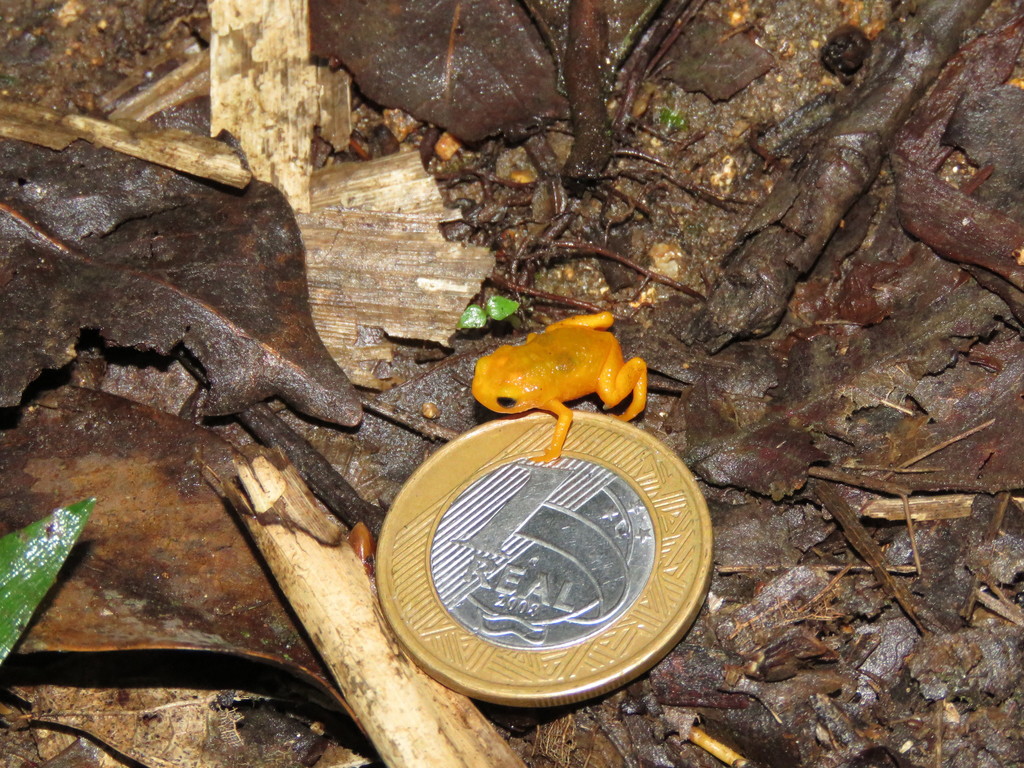
Photo: Diogo Luiz
Feravox · The Voice of the Wild
Pumpkin Toadlet
Brachycephalus ephippium
Least Concern
Pumpkin Toadlet (Brachycephalus ephippium) lives in atlantic rainforest leaf litter across southeastern Brazil. Its conservation status is Least Concern.
The pumpkin toadlet, Brachycephalus ephiphium, is a diminutive marvel of Brazil’s Atlantic rainforests, measuring just 12.5–19.7 mm from snout to vent. Though tiny, it ranks among the largest of its genus, with females outpacing males and hatchlings emerging at a minuscule 5.25–5.45 mm. Its most arresting feature is the brilliant yellow-orange hue that cloaks adults, a vivid aposematic banner warning predators of a potent cocktail of toxins, most notably 11-oxotetrodotoxin, a compound four to five times more lethal than the famed tetrodotoxin. These toxins concentrate in the liver, skin, and ovaries, making the toadlet a living chemical deterrent. It dwells in leaf litter at 200–1,250 m across Espírito Santo, Rio de Janeiro, southeastern São Paulo, and southeastern Minas Gerais, where it hunts minute invertebrates and reproduces by direct development, bypassing the tadpole stage entirely. Beyond its toxic brilliance, the pumpkin toadlet harbors a hidden fluorescence: under ultraviolet light, its skull and back emit a ghostly glow, a trait it shares with its close cousin, the red pumpkin toadlet. Juveniles, still cloaked in brown camouflage, lack this glow even after acquiring adult coloration, suggesting the fluorescence is not a primary warning signal. The species also defies conventional amphibian communication, its under-developed ears cannot perceive its own call, so it relies on visual cues like an inflating vocal sac, mouth gaping, and arm waving. This blend of chemical defense, luminous skeleton, and unconventional signaling makes the pumpkin toadlet a striking example of evolutionary innovation, continually prompting researchers to wonder how such tiny creatures navigate a world of predators and mates…
Real recorded sounds, 11 nature games and a free Daily 5, 1v1 quiz duels, conservation wins and a safe Kids mode. Free on Feravox.