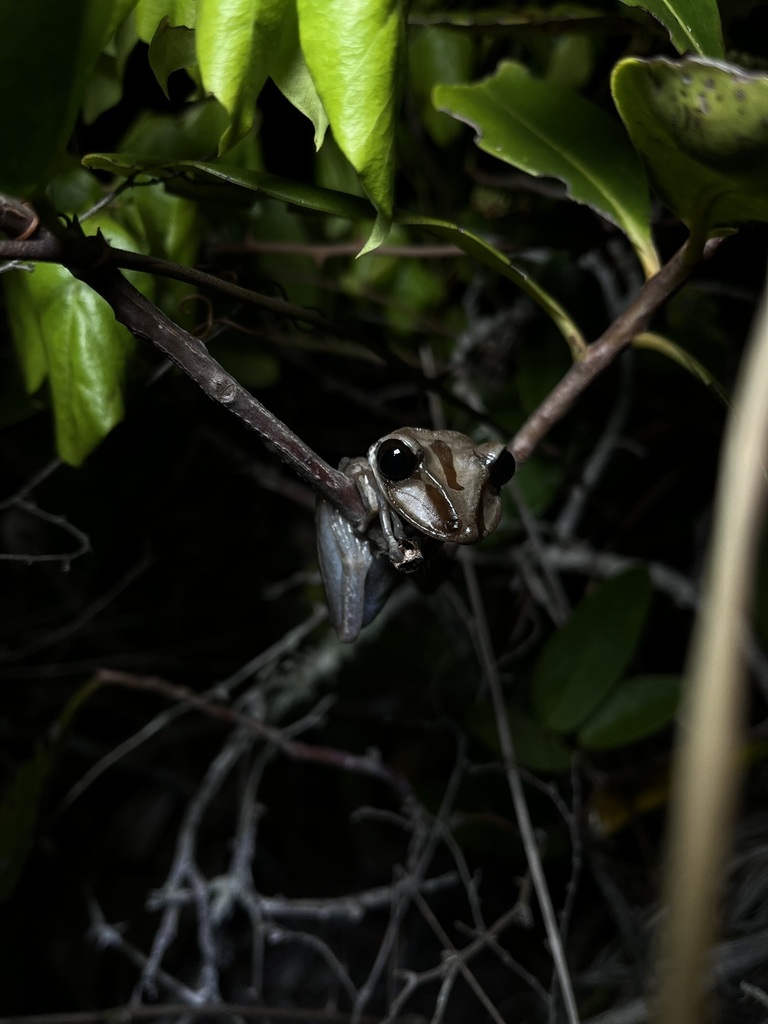
Photo: Henrique Nogueira
Feravox · The Voice of the Wild
Bruno's Casque-headed Frog
Nyctimantis brunoi
Least Concern
Bruno's Casque-headed Frog (Nyctimantis brunoi) lives in tropical moist forest across southeastern Brazil. Its conservation status is Least Concern.
Bruno's casque-headed frog, Nyctimantis brunoi, is a relatively large hylid, with males measuring 4.9–6.2 cm and females 5.6–8.1 cm from snout to vent. Its head is a broad, flattened shield crowned by a long, pointed snout and a forest of sharp, spine-like projections that are fused to the skull, giving the species its distinctive “casque.” The dorsal skin ranges from pale brown to gray, splashed with irregular dark markings, while long, slender legs end in adhesive discs that let the frog cling to wet bark, bamboo, and the water-filled rosettes of bromeliads. By day it tucks itself into water-filled hollows or crevices that match its head’s dimensions, sealing the entrance with its armored skull – a behavior that both hides it from predators and creates a tiny, humid micro-habitat. The most startling trait is its venomous head-butt: skull spines can inject a toxin estimated to be 25 times more lethal than that of local fer-de-lance pit vipers, with an LD50 of 0.16 mg/kg intraperitoneally, a defensive arsenal it shares only with the similarly armed Corythomantis greeningi. Endemic to the coastal stretch of southeastern Brazil, from Bahia down to northern São Paulo, the species inhabits subtropical and tropical moist lowland forests, shrubland, and intermittent freshwater marshes up to about 500 m altitude.
Real recorded sounds, 11 nature games and a free Daily 5, 1v1 quiz duels, conservation wins and a safe Kids mode. Free on Feravox.