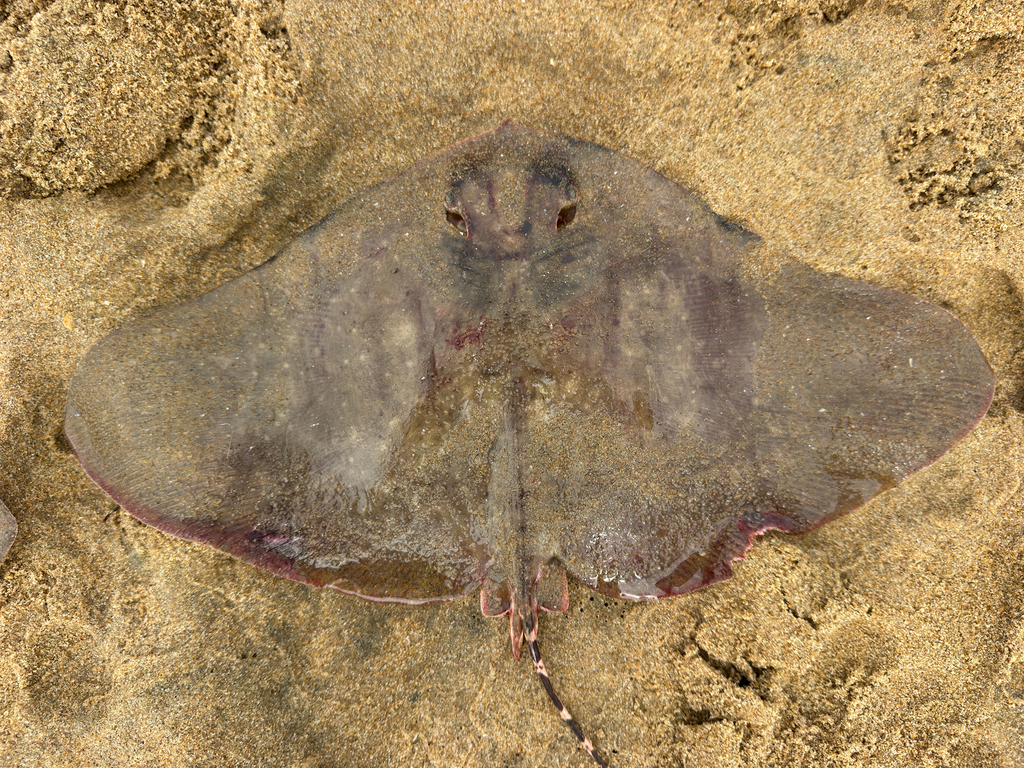
Photo: Teja Yantrapalli
Feravox · The Voice of the Wild
Longtail Butterfly Ray
Gymnura poecilura
Vulnerable
Longtail Butterfly Ray (Gymnura poecilura) lives in sandy or muddy coastal across Indo-Pacific. It feeds on bony fishes, molluscs, crustaceans. Its conservation status is Vulnerable.
Gliding just above the sand, the longtail butterfly ray (Gymnura poecilura) presents a striking lozenge-shaped disc that is roughly twice as wide as it is long, reaching up to 92 cm (36 in) across. Its dorsal surface is a muted brown-to-gray canvas dotted with countless pale speckles, while the slender, thread-like tail, about as long as the distance from snout to vent, sports nine to twelve alternating black and white bands, each often marked by a tiny dark spot. The eyes sit above smooth-rimmed spiracles, and a short, broad curtain of skin guards a mouth that can hold over 50 rows of tiny, pointed teeth, increasing with age. Beneath, the belly is stark white, darkening toward the fin edges, giving the ray a ghostly silhouette as it drifts over sandy or muddy bottoms. A true bottom-dweller, this ray inhabits coastal waters shallower than 30 m (98 ft) across the Indo-Pacific, from the Red Sea to southern Japan and western Indonesia. It preys on bony fishes, especially ponyfishes of the genus Leiognathus, along with molluscs and crustaceans, hunting alone rather than in large schools. Reproduction is viviparous: embryos first rely on yolk, then on a nutrient-rich histotroph, or “uterine milk,” supplied by the mother. Females bear litters of up to seven pups year-round, with a peak from April to October, and newborns emerge already resembling miniature, stingless adults, a surprising reminder of the ray’s evolutionary efficiency.
Real recorded sounds, 11 nature games and a free Daily 5, 1v1 quiz duels, conservation wins and a safe Kids mode. Free on Feravox.