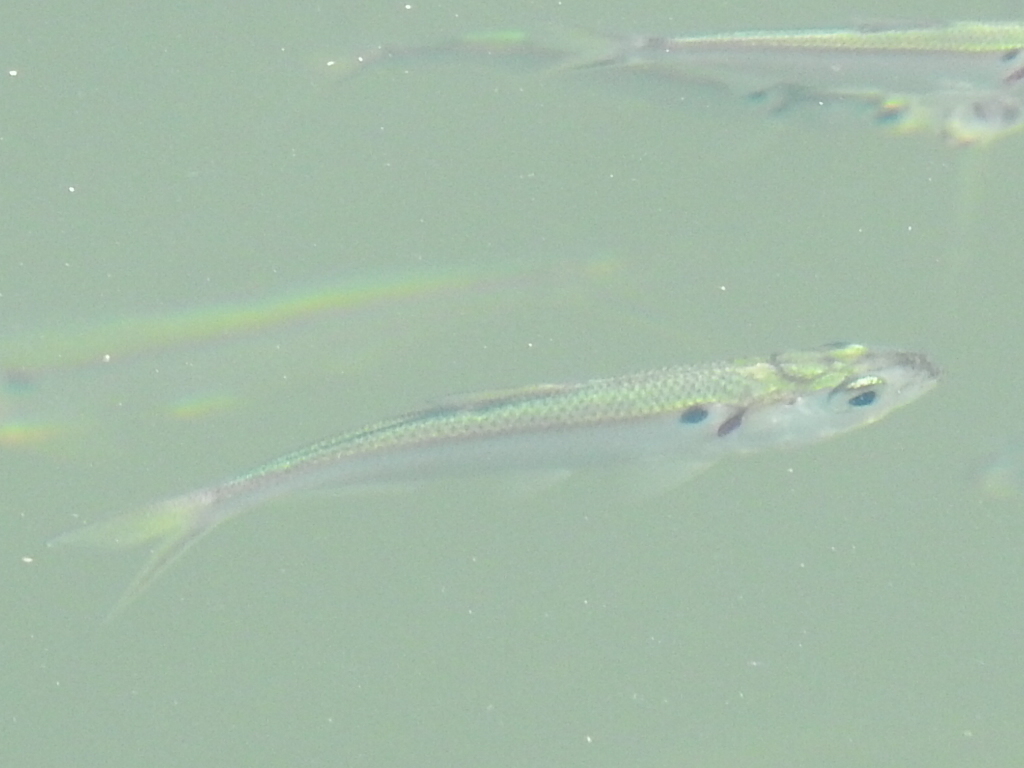
Photo: Sam Kieschnick
Feravox · The Voice of the Wild
Threadfin Shad
Dorosoma petenense
Least Concern
Threadfin Shad (Dorosoma petenense) lives in pelagic freshwater lakes across Southeastern US. It feeds on planktonic organisms and debris. Its conservation status is Least Concern.
The threadfin shad (Dorosoma petenense) glides through the warm surface waters of the Southeast’s lakes, reservoirs, and large streams, its slender body capped by an elongated dorsal fin and yellow-tinged caudal and other fins. Its back shimmers in shades of grey to blue, punctuated by a dark shoulder spot, while most individuals are only about an inch (2.5 cm) long, though a few reach the rare 8-inch (200 mm) maximum. Unlike its cousin, the American gizzard shad, the threadfin’s mouth sits terminally without a projecting upper jaw, a subtle adaptation that lets it snap up planktonic prey and organic debris as it drifts in schools that surface at dawn and dusk. These schools, sometimes mingling with gizzard shad, move from deeper water by day to shallow, vegetation-sparse zones by night, exploiting the pelagic niche across depths to 50 metres (160 ft). A surprising trait is its extreme sensitivity to temperature and dissolved-oxygen shifts: when water cools to 42 °F, massive die-offs can sweep through populations, turning tranquil lakes into odorous, fish-laden shorelines. Threadfin shad are a cornerstone forage for prized game fishes, striped bass, largemouth and smallmouth bass, and catfish all rely on their abundant, oily bodies. Spawning erupts in spring when waters climb into the upper 60s °F; females scatter 2,000 to 24,000 adhesive eggs among floating or submerged vegetation, with a secondary fall spawn sometimes following. The young mature within a year, but the species rarely lives beyond two to three years, making each reproductive burst vital. Their introduction across the United States, from the Gulf basin to the West Coast’s Oregon-San Diego Bay corridor, has broadened their range, yet the very act of moving them into colder northern waters often sets the stage for the fatal 42 °F die-offs that echo through both human and wildlife communities.
Real recorded sounds, 11 nature games and a free Daily 5, 1v1 quiz duels, conservation wins and a safe Kids mode. Free on Feravox.