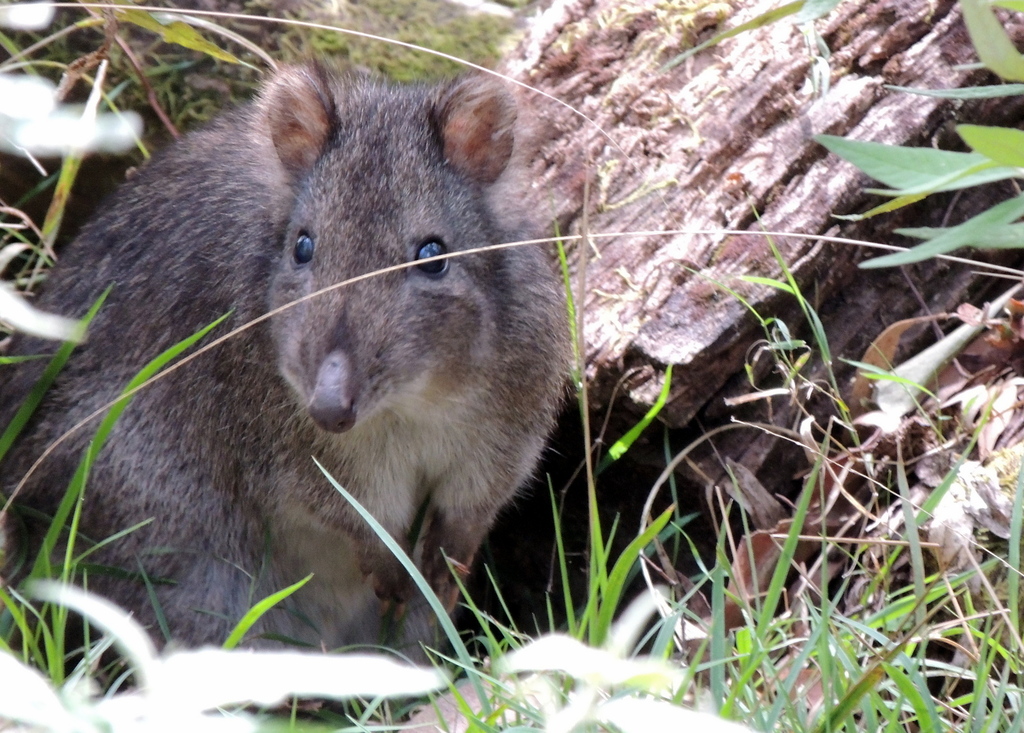
Long-nosed Potoroo (Potorous tridactylus) lives in eastern Australian forests across Eastern Australia. It feeds on fungi and roots. Its conservation status is Near Threatened.
Fascinating facts about the Long-nosed Potoroo
- The long-nosed potoroo can occupy an exceptionally large home range for its modest size, with the biggest individual recorded covering 34.4 hectares. In Tasmania, individuals commonly maintain overlapping territories that range from 5 to 20 hectares, and males tend to claim more ground than females. By contrast, potoroos in Victoria hold considerably smaller areas.
- Feeding primarily on underground fungi, the long-nosed potoroo ingests fungal fruiting bodies and later excretes viable spores in its droppings, effectively dispersing them across the forest floor. Those spores can germinate on the roots of native plants, where the resulting mycorrhizal relationships improve the plants' ability to draw nutrients from the soil.
- Measuring just 34 to 38 cm in body length, the long-nosed potoroo is a compact marsupial with a semi-prehensile tail that adds another 15 to 24 cm. It has an elongated pointed nose, erect ears, large eyes and powerful hind legs that enable agile hopping and precise digging.
- The long-nosed potoroo lives solitarily and does not defend a fixed territory, so its home ranges often overlap with those of neighbours. A male's range can intersect the areas of several females, while each female typically maintains an exclusive zone that she alone occupies.
- The first European record of the long-nosed potoroo dates to 1790, when John White noted the animal during his journey to Botany Bay. In his journal he described it as a "Poto Roo" or "Kangaroo Rat" and even included an illustration of the creature. This early informal naming preceded the later scientific classification of the species as Potorous tridactylus.
Sources
Every fact above was checked against these pages, and kept only where one of them states it.
At a glance
RangeEastern Australia
HabitatEastern Australian forests
DietFungi and roots
About the Long-nosed Potoroo
In the shadowy undergrowth of eastern Australia's forests, the long-nosed potoroo weaves a secretive path, its oversized snout twitching with every scent and sound as it forages for the tender shoots and fungi that sustain it. With a gentle, loping gait, this small, wallaby-like marsupial moves unseen, its earthy coat blending seamlessly into the leaf litter as it navigates the dense, moss-carpeted world that is its domain. As it pauses to nibble on a particularly succulent morsel, the potoroo's large, dark eyes gleam with a quiet, unassuming intelligence, a testament to the remarkable adaptability of this often-overlooked creature.
Common questions
What does the Long-nosed Potoroo eat?
Diet: fungi and roots.
Where does the Long-nosed Potoroo live?
Range: Eastern Australia.
Is the Long-nosed Potoroo endangered?
The Long-nosed Potoroo is listed as Near Threatened on the IUCN Red List.
Hear the Long-nosed Potoroo, and 4,400+ more
Real recorded sounds, 11 nature games and a free Daily 5, 1v1 quiz duels, conservation wins and a safe Kids mode. Free on Feravox.