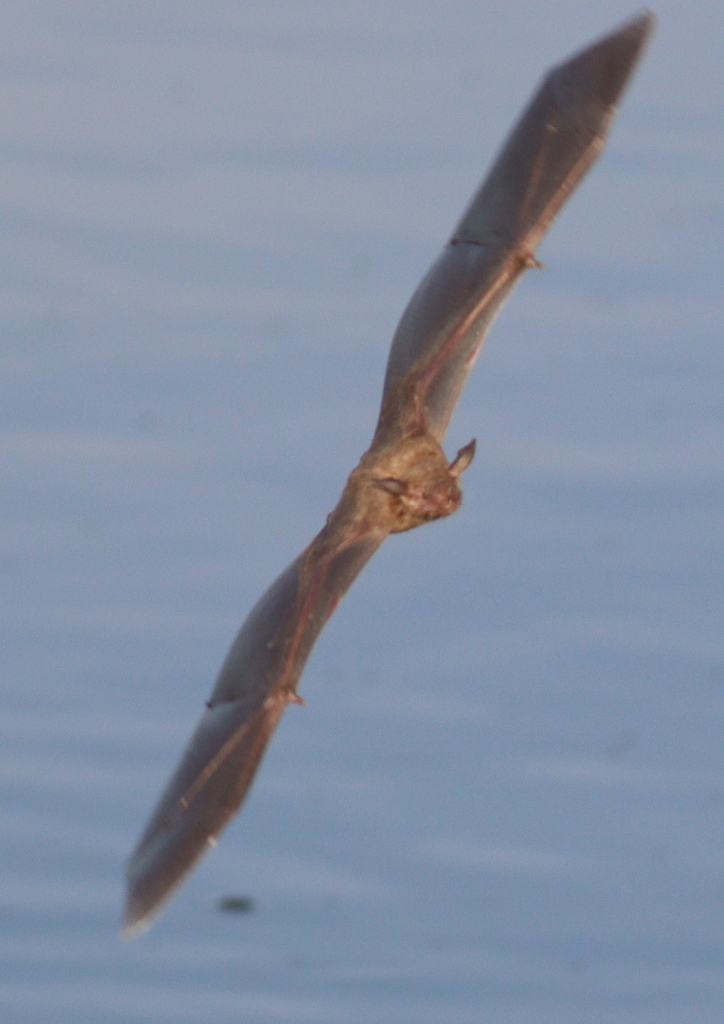
Lesser Bulldog Bat (Noctilio albiventris) lives in tropical rainforest across Central and South America. It feeds on fish and insects. Its conservation status is Least Concern.
Fascinating facts about the Lesser Bulldog Bat
- When insects or small fish gather near the water's edge, the lesser bulldog bat will rake the surface with its enlarged hind claws, a behaviour termed gaffing. This sweeping motion allows the bat to snag prey that are floating or just below the surface. Its large, claw-like feet are specially adapted for this task, giving the species a distinct advantage in aquatic hunting zones.
- The species shows pronounced sexual dimorphism, with males considerably larger than females and bearing a distinct sagittal crest. Adults measure about three inches (7.5 cm) in total length, have forearms around 6.4 cm, and weigh roughly 30 g, but males exceed these dimensions noticeably. This size gap is evident despite the overall small body size, and the crest further accentuates the male's larger skull.
- Each evening the bats leave their daytime roost about half an hour after sunset and embark on one to four short foraging excursions. The combined flight time across these trips totals roughly two hours, during which the animals move mainly in groups rather than alone. They typically select roost sites close to water bodies, facilitating quick access to both aerial and aquatic prey.
- Young lesser bulldog bats begin life silent to the world, unable to emit any echolocation sounds for the first week after birth. Once they are a week old they start producing simple frequency-modulated clicks, a basic FM signal used for initial orientation. As they mature they add more complex pulse types, first quasi-constant-frequency calls and later combined CF-FM pulses that improve target detection and spatial resolution.
- Among the few predators that regularly attack lesser bulldog bats, the great rufous woodcreeper is notable for breaking into their roosts and killing occupants. It does this by pecking the bats with its sharp beak, a behaviour recorded in several roost sites. While overall bat predation is uncommon, large birds such as this woodcreeper, along with hawks, falcons and owls, are recognised as the main avian threats to the species.
Sources
Every fact above was checked against these pages, and kept only where one of them states it.
At a glance
RangeCentral and South America
HabitatTropical rainforest
DietFish and insects
About the Lesser Bulldog Bat
In the velvety darkness of the tropical night, the Lesser Bulldog Bat emerges, its leathery wings beating in a slow, hypnotic rhythm as it navigates the mist-shrouded waters with ease. With its acute echolocation calls, it probes the aquatic world, plucking unsuspecting fish from the surface with a swift, aerial precision that belies its somewhat cumbersome appearance. As it flits and swoops, its large, round eyes gleam like lanterns in the dark, illuminating a mastery of the nocturnal realm that is at once fascinating and humbling.
Hear the Lesser Bulldog Bat, and 4,400+ more
Real recorded sounds, 11 nature games and a free Daily 5, 1v1 quiz duels, conservation wins and a safe Kids mode. Free on Feravox.