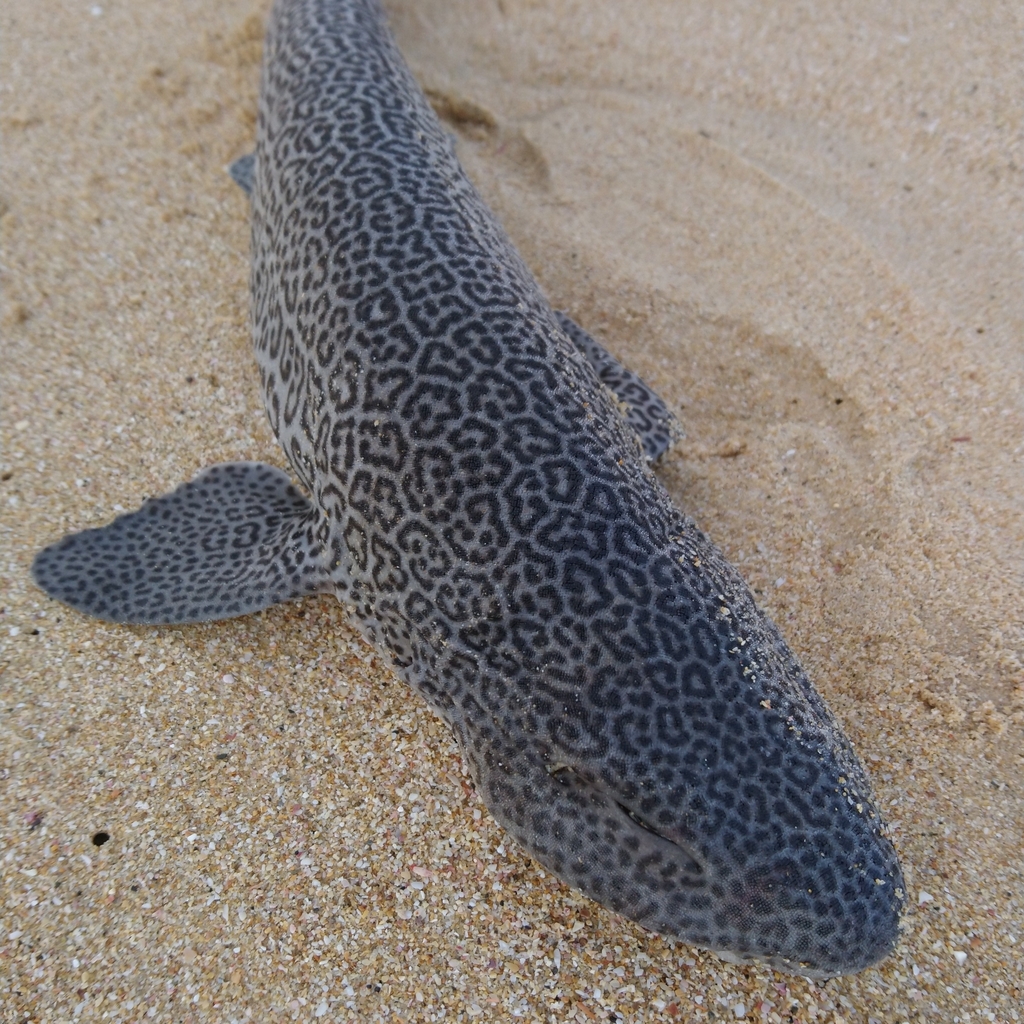
Photo: Henry de Lange
Feravox · The Voice of the Wild
Leopard Catshark
Poroderma pantherinum
Least Concern
Leopard Catshark (Poroderma pantherinum) lives in rocky reefs, kelp beds across South Africa. It feeds on small benthic fish and invertebrates. Its conservation status is Least Concern.
In the kelp-fringed reefs and sandy flats of South Africa’s coastal waters, the leopard catshark (Poroderma pantherinum) glides with a stout, laterally-compressed body that can reach 84 cm (33 in). Its skin, thick and armored with arrow-shaped denticles, is a living canvas: individuals range from ghost-white to jet-black, overlaid with a kaleidoscope of spots, rosettes, blotches and lines that shift with age and location. Four named forms, typical, marleyi, salt-and-pepper, and melanistic, dot the shoreline from Saldanha Bay to the Tugela River mouth, hinting at a patchwork of local populations. By day the sharks tuck themselves into crevices, sometimes in groups, while nightfall releases them to hunt the shallow seafloor. Their nocturnal menu is a buffet of small bony fishes, cephalopods and crustaceans; in False Bay they favor fish, then cephalopods, and even the Cape rock lobster (Jasus lalandii). A surprising tactic sees them lying motionless among spawning chokka squid (Loligo vulgaris reynaudi) egg masses, then lunging at descending females, a brief, opportunistic break from their usual night-time foraging. Reproduction is continuous, with females depositing paired, rectangular egg capsules that cling to the substrate via tendrils, hatching after about five and a half months into 11 cm (4.3 in) hatchlings that will grow for a decade before reaching maturity.
Real recorded sounds, 11 nature games and a free Daily 5, 1v1 quiz duels, conservation wins and a safe Kids mode. Free on Feravox.