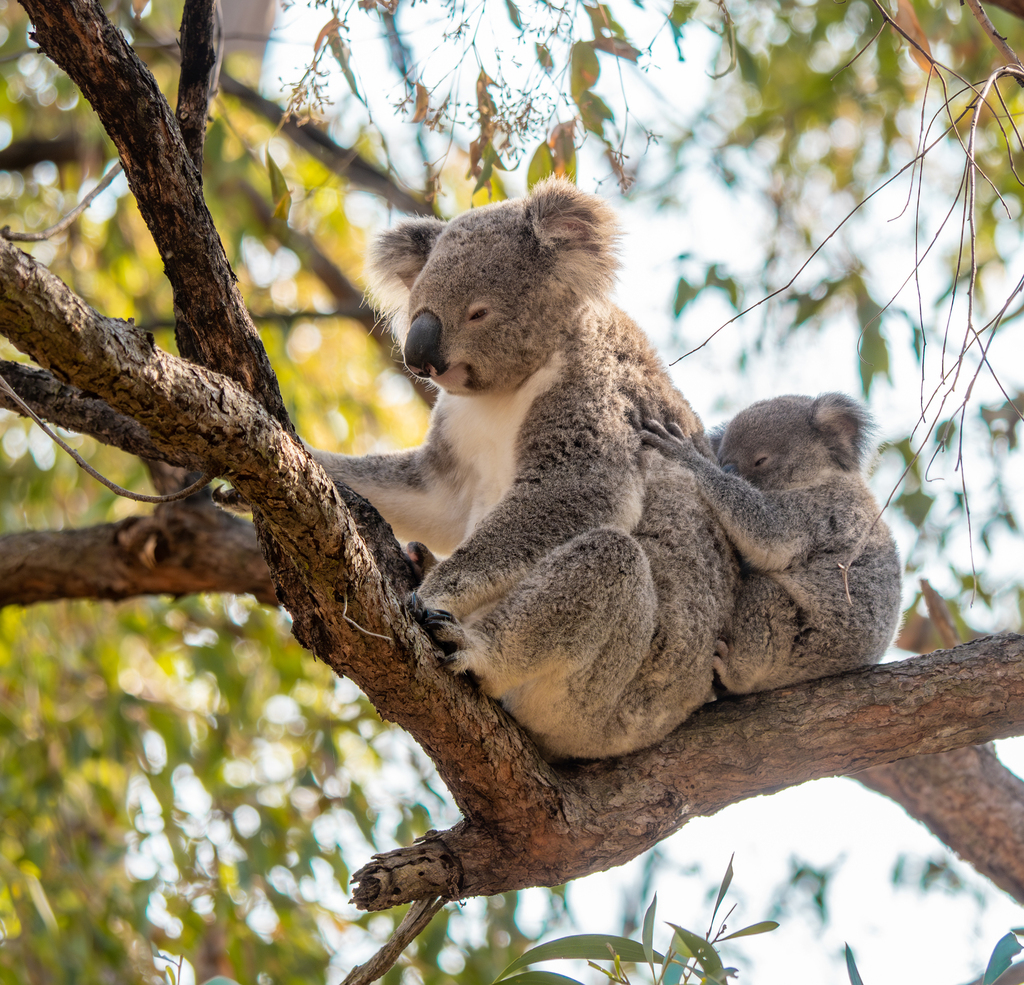
Koala (Phascolarctos cinereus) lives in eastern Australian forests across Eastern Australia. It feeds on eucalyptus leaves only. Its conservation status is Vulnerable.
Hear the Koala
A real field recording of the Koala, made in the wild.
Koalas from Victoria can be twice as heavy as their northern cousins, with southern males averaging 11.8 kg and females 7.9 kg, while northern males weigh about 6.5 kg and females 5.1 kg. Their head-body length also varies, southern males reaching an average 78 cm compared with 72 cm in southern females. Across the whole species, body length ranges from 60-85 cm and weight from 4-15 kg.
A koala can chew up to 400 g (14 oz) of eucalyptus leaves each day, spreading the meals over four to six feeding bouts. Those leaves are so low-calorie that the animal's hindgut can retain food for 100 hours in the wild (200 hours in captivity), yet only about 10 % of its energy comes from that fermentation chamber. This extreme efficiency lets the koala survive on a diet that would starve most mammals, but it also forces the animal to conserve every ounce of energy, shaping its slow, sedentary lifestyle.
Koalas spend most of their lives perched in trees, sleeping up to twenty hours a day according to one source and up to eighteen hours a day according to another. When they do leave the canopy, it's rarely: they climb down only 2-3 times each night, totaling around ten minutes, less than one percent of their daily time budget.
A newborn koala, weighing less than half a gram, crawls into its mother's pouch and stays there for six to seven months, nursing on milk before beginning to sample the toxic eucalyptus leaves that will later sustain it. After leaving the pouch, the joey clings to its mother's back for several more months, finally becoming independent at around one year of age.
The koala is listed as vulnerable by the IUCN, but in February 2022 it was upgraded to endangered in three Australian jurisdictions: the Australian Capital Territory, New South Wales, and Queensland. This rapid status change reflects accelerating habitat loss from agriculture, urban expansion, drought and climate-driven wildfires, which together threaten the eucalyptus woodlands the animals depend on.
Sources
Every fact above was checked against these pages, and kept only where one of them states it.
In the sun-dappled eucalyptus forests of eastern Australia, the koala embodies a paradox of languid elegance, its soft, grey fur and rounded form belied by an unexpected agility as it navigates the treacherous network of branches with ease. With a calm, almost meditative air, the koala moves through its arboreal world, pausing to pluck a tender leaf from the tips of the trees that sustain it, its large, round nose twitching as it savors the scent of its surroundings. As it settles into a cozy ball, paws clasped gently around a sturdy limb, the koala seems a symbol of serene contentment, its very existence a poignant reminder of the beauty and fragility of life in the wild.
Advertisement
Hear the Koala, and 4,400+ more
Real recorded sounds, 11 nature games and a free Daily 5, 1v1 quiz duels, conservation wins and a safe Kids mode. Free on Feravox.