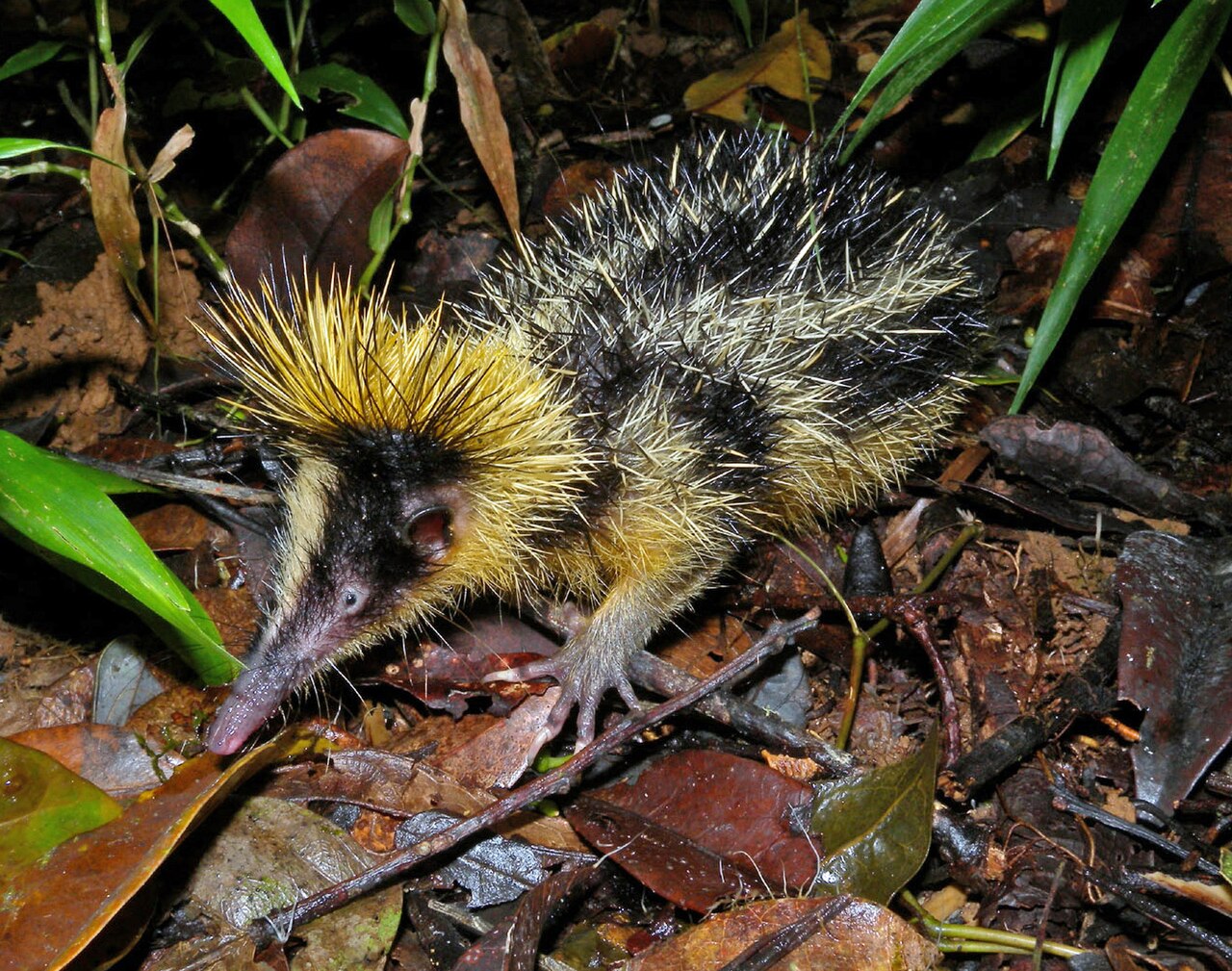
Lowland Streaked Tenrec (Hemicentetes semispinosus) lives in madagascar forests across Eastern Madagascar. Its conservation status is Least Concern.
Fascinating facts about the Lowland Streaked Tenrec
- The lowland streaked tenrec is the sole mammal known to generate sound by rubbing specialised quills together, a technique called stridulation that is otherwise limited to insects and snakes. Its mid-dorsal quills form three rows of seven to sixteen quills, and when erected they rub against each other to emit a high-frequency noise.
- When threatened, the lowland streaked tenrec can shed its dorsal quills, which detach to distract predators and aid its escape. The quills are clustered in the mid-dorsal region in groups of seven to sixteen arranged in three rows, and each quill can break away when the animal erects them laterally and forward. This defensive display also produces a rattling sound as the quills vibrate against one another.
- The lowland streaked tenrec often beats its fore-paws on the forest floor, a rhythmic stamping that is believed to coax earthworms to the surface and make them easier to capture. It is active both by day and by night, spending much of its foraging time probing the soil with its elongated snout to locate prey. Earthworms form the bulk of its diet, although it will also take other invertebrates and occasional fruit.
- Female lowland streaked tenrecs reach reproductive maturity at about 35 days old, so they can conceive in less than two months after birth. Breeding in the wild occurs from October to December, although local food supply and temperature can shift the timing. After a gestation of 58 days the mother gives birth to five-to-eight pups, which are weaned in just 18-25 days, allowing the young females to join the next breeding cohort within the same season.
- The lowland streaked tenrec produces its characteristic high-frequency sound using specialised cutaneous muscles beneath the mid-dorsal quills. These muscles, called quill vibrator discs, measure roughly 16.8 mm in length and 8.55 mm in width in adults, and their contraction makes the quills rub together. The resulting ultrasonic vibration is used for communication, especially during predator alerts and social encounters, and is too high for human ears to hear.
Sources
Every fact above was checked against these pages, and kept only where one of them states it.
At a glance
RangeEastern Madagascar
HabitatMadagascar forests
DietInsects and worms
About the Lowland Streaked Tenrec
In the lush undergrowth of Madagascar's forests, the lowland streaked tenrec darts and weaves with frenetic energy, its long, pointed snout twitching as it snuffles out insect prey amidst the leaf litter. As it moves, its unique, barbed quills bristle and rattle, a startling defense mechanism that deters potential predators and serves as a reminder of this remarkable creature's singular adaptability. With its bold, striated fur and irrepressible spirit, the lowland streaked tenrec embodies the untamed essence of its island home.
Hear the Lowland Streaked Tenrec, and 4,400+ more
Real recorded sounds, 11 nature games and a free Daily 5, 1v1 quiz duels, conservation wins and a safe Kids mode. Free on Feravox.