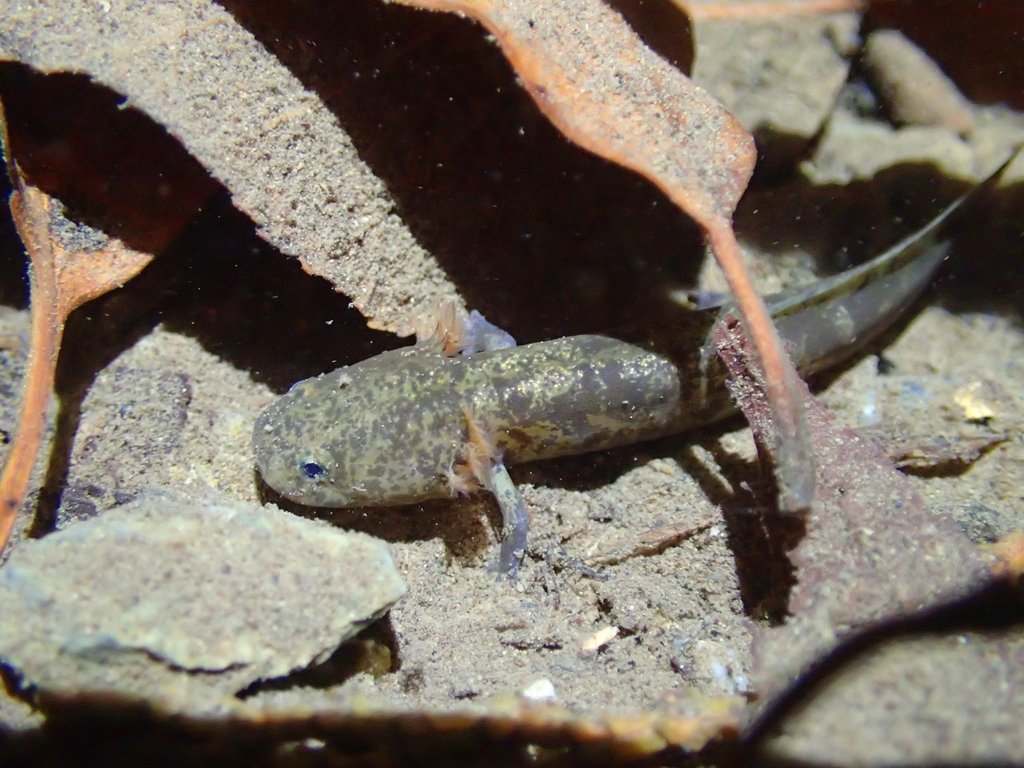
Photo: iNaturalist
Feravox · The Voice of the Wild
Japanese Rift Salamander
Hynobius fossigenus
Vulnerable
Japanese Rift Salamander (Hynobius fossigenus) lives in mountain streams evergreen forest across Honshu, Japan. Its conservation status is Vulnerable.
The Japanese Rift Salamander, Hynobius fossigenus, is a striking amphibian that drifts through the mist-cloaked mountain streams of central Honshu. Measuring 66–82.5 mm in length, its slender, cylindrical body is cloaked in a smooth skin that shimmers from brown-purple to a deep, faded black, punctuated by golden-yellow or orange irregular spots that catch the dappled light. Its broad, oval head occupies a quarter of its length, while a long, slightly shorter tail tapers from a thick base. Prominent parotoid glands sit between the lower jaw and throat, and a row of about 56 U-shaped vomerine teeth line its dental arch, ready for the small invertebrates it pursues. In the evergreen Cryptomeria japonica forests that fringe its alpine habitats, the salamander slips beneath rocks and leaf litter, emerging at night to hunt spiders, insects, and worms, while its tadpoles, once hatched from thick, transparent egg envelopes, scavenge amphipods and aquatic larvae beneath the cold, 5.5–6.5 °C waters. Breeding unfolds from December to April, when adults migrate to narrow (under 1.5 m wide) streams at 300–1 100 m elevation, preferring depths of 20–30 cm where water never exceeds 20 °C. After a terrestrial courtship in burrows beneath stones, females deposit their eggs in sturdy, violet-fluorescent sacs that cling to rocks or waterfalls for sixty days. The larvae remain in these protective envelopes until hatching, then cling to the streambed for up to a year before metamorphosing into terrestrial imagos. Males reach sexual maturity at about five years, females at seven, a slow life history that underscores the species’ reliance on stable, undisturbed waterways, an unexpected vulnerability for a creature that seems so at home in the torrent’s roar.
Real recorded sounds, 11 nature games and a free Daily 5, 1v1 quiz duels, conservation wins and a safe Kids mode. Free on Feravox.