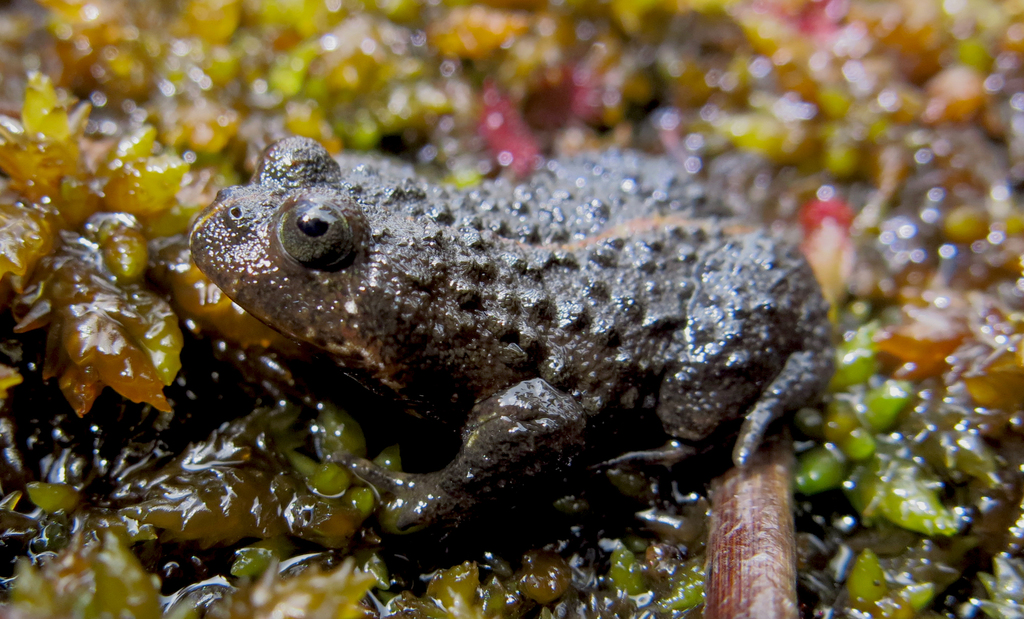
Photo: Ryan van Huyssteen
Feravox · The Voice of the Wild
Montane Marsh Frog
Poyntonia paludicola
Near Threatened
Montane Marsh Frog (Poyntonia paludicola) lives in montane fynbos across Western Cape. It feeds on diet not described. Its conservation status is Near Threatened.
The Montane Marsh frog, Poyntonia paludicola, is a compact, warty amphibian that looks more like a tiny toad than a typical frog. Adults measure just 27–30 mm, with females edging out males, and their stout bodies are cloaked in a carpet of warts, including a distinctive raised patch behind each eye. A subtle red-orange stripe runs along the spine, while a white, teardrop-shaped mark streaks from the lower eye toward the forearm, giving each individual a unique facial signature. Their fingers bear only slight webbing, and the long, disc-less toes end in blunt tips, adaptations that suit their life among the shallow, often muddy seepage pools of the Western Cape’s montane fynbos. When sunrise paints the mist-laden hills, males launch a coarse "kruck-kruck-kruck" chorus, one to six brief chirps at a rapid three-per-second rhythm, calling from exposed seepage edges where they lay clutches of relatively large eggs, such as the 15-egg clutch recorded in September 2020. The larvae are benthic, hiding in the mud until they emerge, while the adults remain diurnal, often perched in the open, their pale bellies dotted with irregular dark blotches. These frogs occupy a narrow ecological niche, thriving from sea level to 1,800 m in the rain-rich (2,000–3,000 mm annually) fynbos of the Kogelberg, Hottentots-Holland, and Klein River mountains. Their breeding sites are shallow, water-flowing seepage pools, sometimes mere centimeters deep, where water abstraction and alien plant encroachment threaten the delicate hydrology. Yet the species shows surprising resilience: it tolerates modest anthropogenic disturbance, persisting in eroded ditch margins beside jeep tracks, and its breeding calls resume quickly after fire, once the first good rains return. This combination of specialized habitat preference and unexpected adaptability makes the Montane Marsh frog a compelling example of how even the most seemingly fragile amphibians can navigate a changing landscape
Real recorded sounds, 11 nature games and a free Daily 5, 1v1 quiz duels, conservation wins and a safe Kids mode. Free on Feravox.