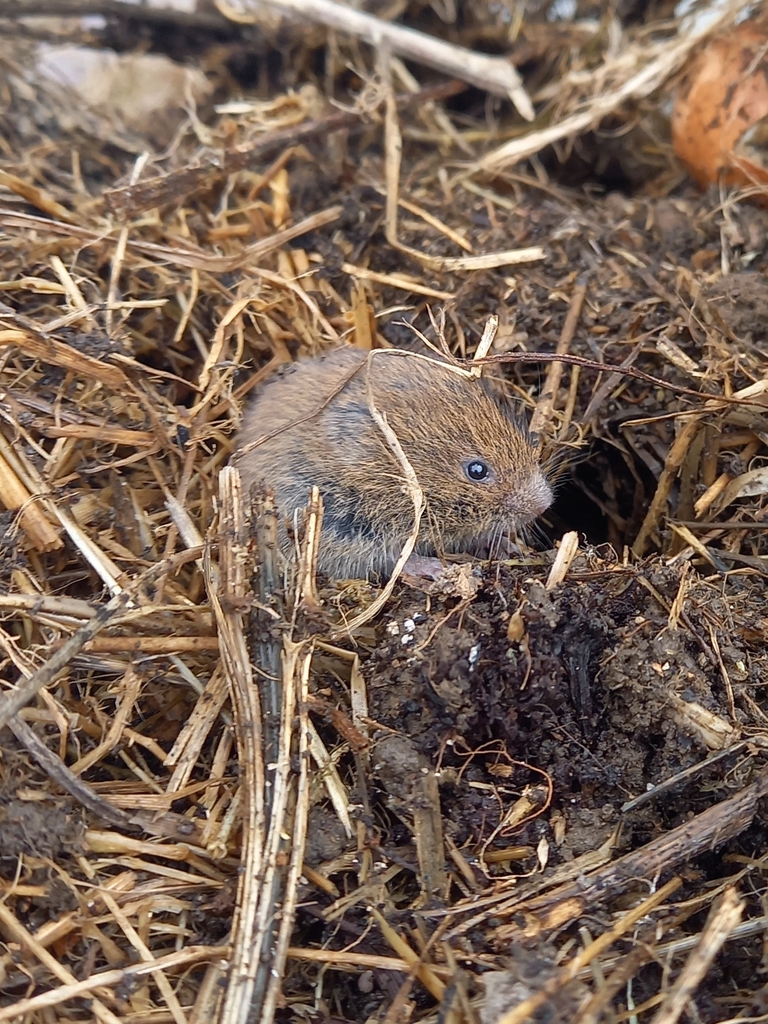
Field Vole (Microtus agrestis) lives in grassland areas across Northern Europe and Asia. It feeds on grass and seeds. Its conservation status is Least Concern.
Fascinating facts about the Field Vole
- At just 8-13 cm long and weighing only 20-50 g, the short-tailed field vole has a stubby tail of 3-4 cm. It slips through dense grass and burrows shallowly under leaf litter, escaping predators that can't follow. Its low energy reserves last only five to fourteen hours.
- A female short-tailed field vole can produce up to seven litters a year, each with four to six pups that are weaned after about fourteen days. Gestation lasts roughly three weeks, and a single litter may contain up to a dozen young. The newborns suckle for twelve days, leave the nest at twenty-one days, and reach sexual maturity soon after.
- Spanning from the Atlantic coast to Lake Baikal and even reaching Ireland in 2022, the short-tailed field vole occupies a palearctic belt that climbs to about 1,700 m (5,600 ft). It prefers moist grasslands, marshes, and river banks, and thrives from sea level up to alpine meadows.
- Field voles are an important part of the diet of barn owls, kestrels, weasels, stoats, foxes and snakes. They are listed as "Least Concern" by the IUCN, though local numbers can swing wildly from year to year.
Sources
Every fact above was checked against these pages, and kept only where one of them states it.
At a glance
RangeNorthern Europe and Asia
HabitatGrassland areas
DietGrass and seeds
About the Field Vole
In the whispering grasslands, a tiny, unassuming monarch reigns, the field vole, its diminutive form belied by a fierce will to thrive in a world of giants. With furtive, darting movements, it weaves through the dense undergrowth, its bright, inquisitive eyes ever-vigilant for the lurking shadows of predators, as it constructs a hidden realm of intricate tunnels and chambers. As it navigates this secret world, the field vole embodies a testament to the indomitable power of smallness, its very existence a reminder of the magic that lies just beyond the edge of our perception.
Common questions
What does the Field Vole eat?
Diet: grass and seeds.
Where does the Field Vole live?
Habitat: grassland areas. Range: Northern Europe and Asia.
Is the Field Vole endangered?
The Field Vole is listed as Least Concern on the IUCN Red List.
Hear the Field Vole, and 4,400+ more
Real recorded sounds, 11 nature games and a free Daily 5, 1v1 quiz duels, conservation wins and a safe Kids mode. Free on Feravox.