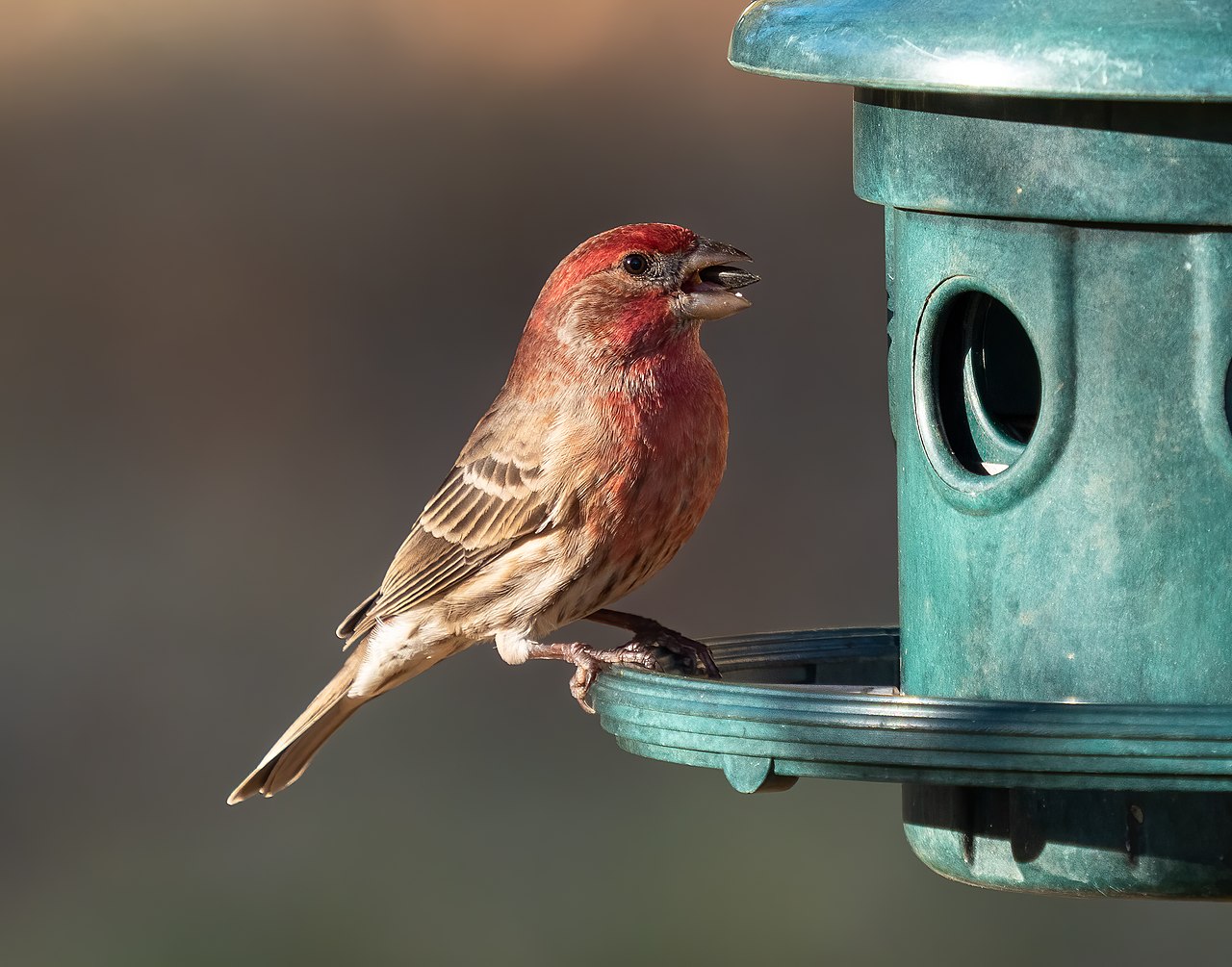
House Finch (Haemorhous mexicanus) lives in desert shrublands across Western North America, eastern half of the continent and Hawaii. Its conservation status is Least Concern.
Fascinating facts about the House Finch
- Forty million house finches now pepper every backyard. Originally only a resident of Mexico and the southwestern United States, house finches were introduced to eastern North America in the 1940s, and they quickly escaped illegal sales in New York City. By 1901, house finches had become abundant on all major Hawaiian islands except Niʻihau and Kahoʻolawe, showing how fast they colonize new lands. The species is labeled as invasive by some organizations, meaning its sheer numbers can push out native birds and alter local ecosystems.
- Female house finches can assemble a cup-shaped nest in as little as two days, weaving twigs and debris into a structure usually perched 1.8 to 2.7 m above ground, about the height of a kitchen countertop. They lay 2 to 6 eggs per clutch, most often four or five, each day in the morning, and then incubate them for 12 to 14 days. After hatching, the pink, down-covered chicks stay silent for a week before begging, and they fledge after 11 to 19 days, ready to join the feeder frenzy. This rapid turnover lets a single pair produce multiple broods each breeding season, fueling their explosive population growth.
- House finches are voracious seed eaters, devouring weed seeds like nettle and dandelion and favoring sunflower or nyjer at feeders. Their diet also includes occasional insects such as aphids, but they rarely need animal protein for their young, feeding nestlings only plant matter. This habit makes them frequent visitors to orchards, where they can damage fruit, and to grain fields, where they nibble commercially grown crops.
- North American surveys show the house finch population has surged by 82.9% over the past 40 years, translating to an average rise of 16.3% each decade. This boom is reflected in both the Breeding Bird Survey and Christmas Bird Count data, confirming a robust upward trend despite occasional regional declines. Such growth secures their status as a species of Least Concern on the IUCN Red List.
- A house finch measures just 12.5 to 15 cm long, with a wingspan of 20 to 25 cm. Its body mass ranges from 16 to 27 g, while the average adult weighs 21 g.
Sources
Every fact above was checked against these pages, and kept only where one of them states it.
At a glance
RangeWestern North America, eastern half of the continent and Hawaii
HabitatDesert shrublands
DietSeeds and fruits
About the House Finch
As the warm sunlight dances across the landscape, the house finch comes alive, its brown plumage glistening with subtle hints of crimson, like the first blush of dawn. With a twitch of its tail and a flutter of its wings, this diminutive bird darts through the garden, its melodic song filling the air as it flits from branch to branch in search of seeds and sweet nectar. In its effortless, aerial ballet, the house finch embodies the very essence of joy and abandon, its unassuming presence a reminder of the beauty that can be found in the most ordinary of places.
Hear the House Finch, and 4,400+ more
Real recorded sounds, 11 nature games and a free Daily 5, 1v1 quiz duels, conservation wins and a safe Kids mode. Free on Feravox.