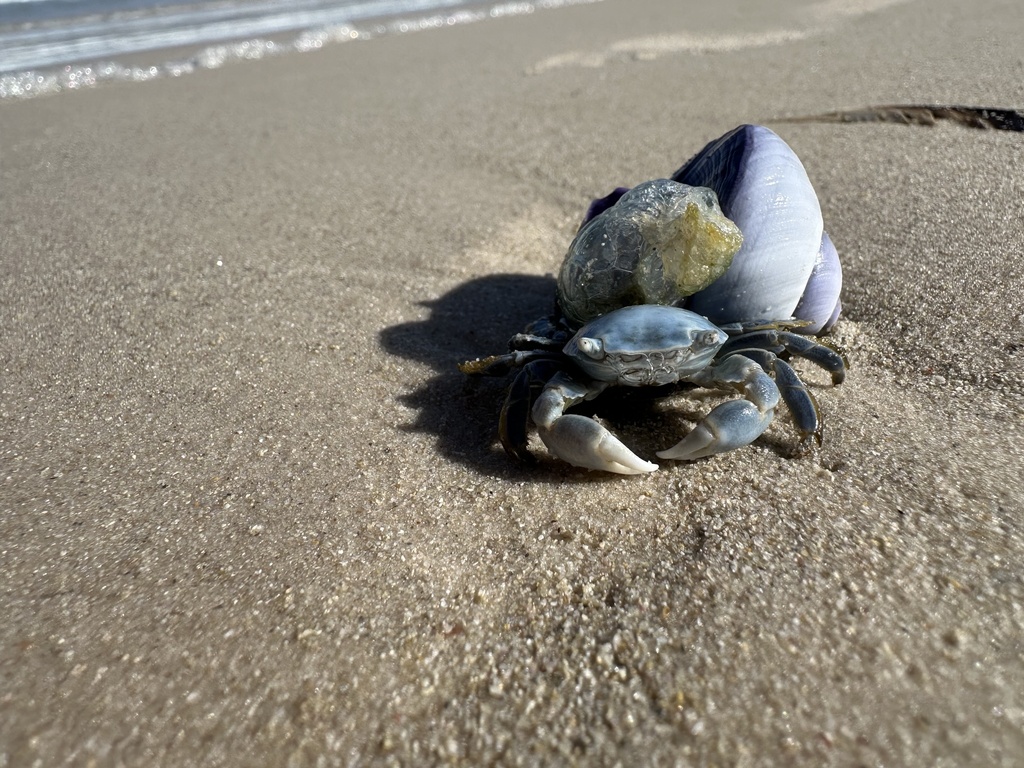
Photo: Michael Silberbauer
Feravox · The Voice of the Wild
Gulfweed Crab
Planes minutus
Not Evaluated
Gulfweed Crab (Planes minutus) lives in pelagic Sargassum weed across North Atlantic. It feeds on small fish, krill, squid.
In the restless currents of the North Atlantic, the Gulfweed Crab, Planes minutus, darts among floating islands of Sargassum, its tiny carapace no larger than a fingernail. Measuring up to 17.5 mm at its widest, the crab’s most striking features are its bulging eyes set in wide orbital sockets and a pair of symmetrically toothed chelae that snap with precision. Its legs, fringed with delicate setae, act like oars, allowing the crab to swim, though only briefly, for less than 45 minutes at 28 °C, before it must return to a floating refuge. Camouflage is its art; the crab’s base hue shifts among brown, yellow, or red, punctuated by white patches that mimic the calcareous tubes of annelid worms, a slow-changing palette that mirrors the ever-moving backdrop of seaweed. When a turtle, often a loggerhead Caretta caretta, glides nearby, the crab may cling to the reptile’s shell, not to feast on waste as once thought, but to clean parasites, an unexpected cleaning partnership that hints at a more intricate ecological role. Its diet is a smorgasbord of small fish, krill, isopods, sea skaters and squid, which it hoards in its tiny claws for later consumption, a behavior that underscores its opportunistic survival strategy, and the crab’s ability to blend, swim, and scavenge makes it a tiny yet resilient thread in the pelagic tapestry, reminding us that even the smallest
Real recorded sounds, 11 nature games and a free Daily 5, 1v1 quiz duels, conservation wins and a safe Kids mode. Free on Feravox.