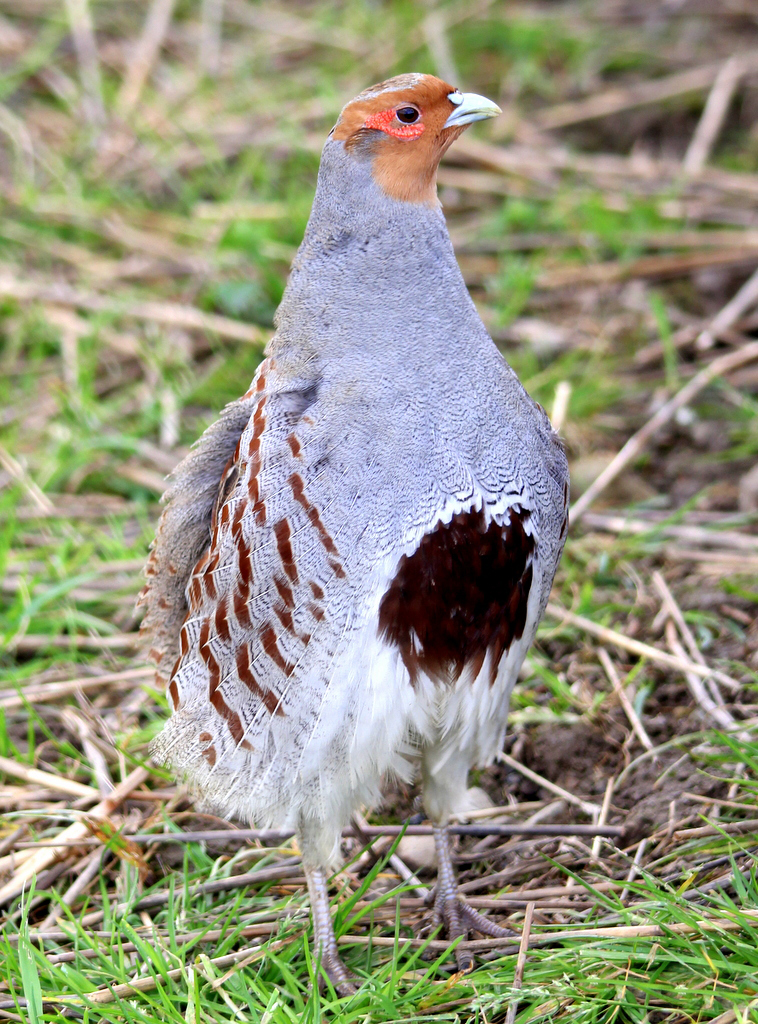
Gray Partridge (Perdix perdix) lives in temperate grasslands across Europe and Asia. It feeds on seeds and insects. Its conservation status is Least Concern.
Hear the Gray Partridge
A real field recording of the Gray Partridge, made in the wild.
At just over a foot long, the grey partridge packs a surprising punch: adults stand between 30.5 and 33 cm tall and weigh 345-500 g, yet the largest subspecies, P. p. robusta, can tip the scales at 350-600 g. This heft lets them sprint across open fields rather than perch, a trait reflected in their anisodactyl feet built for running. Their compact size lets them slip through dense crop cover, escaping predators while still being big enough to crack hard grains with their curved beaks.
A single breeding season can yield up to twenty eggs, but most clutches fall between nine and twenty, each incubated for 23-25 days before hatching. The hatchlings emerge under 10 g, weighing less than a penny, and must rely on insect protein for the first ten days of life. This early insect diet fuels rapid growth, allowing fledging by day 16 and a long dependence on parents for up to eight months, a strategy that ties chick survival tightly to insect abundance in farmland.
In the United Kingdom the grey partridge has declined by up to 85 % over the past 25 years, a collapse driven by intensive farming that strips away hedgerow cover and slashes insect prey with pesticides. Such habitat loss means fewer safe nesting spots and less protein for chicks, pushing the species onto the Birds of Conservation Concern Red List. Efforts such as creating conservation headlands are being made to halt the decline and give fledglings a fighting chance.
Outside the breeding season a covey can spread over an area as small as 2,670 m² or as large as 12,140 m², roughly the size of a soccer field to half a football pitch. This flexible home range lets groups of up to 25 birds exploit scattered grain fields while staying close enough to sound alarms with a distinctive white shoulder patch when danger looms. Such spatial adaptability is key to surviving in fragmented agricultural landscapes where cover and food are patchy.
In the wild a grey partridge may live just under three months or survive up to five years, a span captured by recorded lifespans of 86.5 days to 5.2 years. Shorter lives often result from predation during nesting or the heavy burden of egg-carrying, while older birds that have already secured a mate face lower mortality.
Sources
Every fact above was checked against these pages, and kept only where one of them states it.
Across the rolling hills and sun-drenched meadows, the Gray Partridge moves with a gentle urgency, its mottled plumage blending seamlessly into the rustic landscape as it forages for seeds and insects with quiet intent. With a soft, whirring call, it takes to the skies, its rounded wings beating in a swift, economical rhythm as it hurtles towards the safety of a nearby thicket or the warmth of a wintering flock. As it disappears into the underbrush, the partridge leaves behind a fleeting impression of its unassuming yet resilient presence, a testament to the enduring charm of this humble, yet remarkable, bird.
Advertisement
Hear the Gray Partridge, and 4,400+ more
Real recorded sounds, 11 nature games and a free Daily 5, 1v1 quiz duels, conservation wins and a safe Kids mode. Free on Feravox.