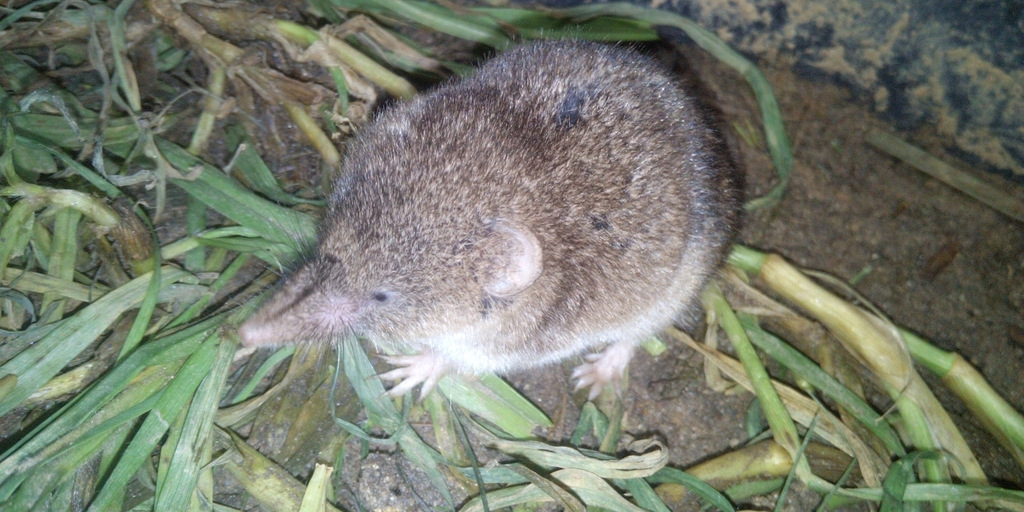
Forest Shrew (Myosorex varius) lives in temperate forests across Southern Africa. It feeds on insects and worms. Its conservation status is Least Concern.
Fascinating facts about the Forest Shrew
- A forest shrew barely fits in the palm of your hand, measuring just 12.5 cm long with a 4.3 cm tail and weighing about 12 g. Its body length averages 12.6 cm, the tail making up roughly 46 % of that length. It burns energy at a basal metabolic rate of 38.9 J per gram each hour and lets its body temperature swing between 33.2 °C and 38.3 °C. Even when the air drops to 6 °C it can crank up heat production to stay alive, showing how tiny mammals juggle size and metabolism to survive extreme climates.
- Forest shrews time their babies to the rains, breeding from September through March when spring and summer are wet. Litters contain 2-5 pups, usually three, each newborn weighing just 1 g. The tiny offspring cling to the mother's fur for the first five days, then form a caravan of teeth-gripping pups. By 20-25 days they are weaned.
- From sea-level grasslands to 1,740 m mountain tops, the forest shrew occupies a huge slice of southern Africa, living in South Africa, Lesotho and Eswatini. Yet size shrinks with altitude: individuals high up are noticeably smaller than their low-land cousins. This altitude-driven dwarfism is observed across its broad range.
- A forest shrew's menu is a nonstop buffet of insects, earthworms, millipedes, centipedes, crustaceans and spiders. Eating these tiny critters makes the shrew a living sponge for whatever chemicals the prey have swallowed. Earthworms soak up lead from polluted soils, and studies show lead levels in shrew tissues rise when they eat those contaminated worms. Because of this, scientists can monitor heavy-metal pollution by testing shrew bodies, turning a tiny mammal into an early warning system for ecosystem health.
- When danger looms, the forest shrew retreats to a shallow burrow it digs or steals, a tunnel network with several entrances and a nesting chamber lined with dry grasses. It spends most of its time underground, venturing out only to feed or relieve itself, because predators like barn owls, water mongooses, striped weasels and striped polecats hunt them above ground. Its droppings are so pungent.
Sources
Every fact above was checked against these pages, and kept only where one of them states it.
At a glance
RangeSouthern Africa
HabitatTemperate forests
DietInsects and worms
About the Forest Shrew
In the damp, emerald depths of the forest, the forest shrew darts and weaves with frenetic energy, its tiny paws barely touching the earth as it pursues an endless quest for insects and seeds. With eyes that shine like dark jewels, this diminutive creature navigates the labyrinthine undergrowth with an uncanny sense of spatial awareness, its long, pointed snout twitching as it uncovers hidden treasures. As it moves, the forest shrew embodies the very essence of frenzied industry, a whirling dervish of fur and hunger that embodies the unrelenting vitality of the natural world.
Hear the Forest Shrew, and 4,400+ more
Real recorded sounds, 11 nature games and a free Daily 5, 1v1 quiz duels, conservation wins and a safe Kids mode. Free on Feravox.