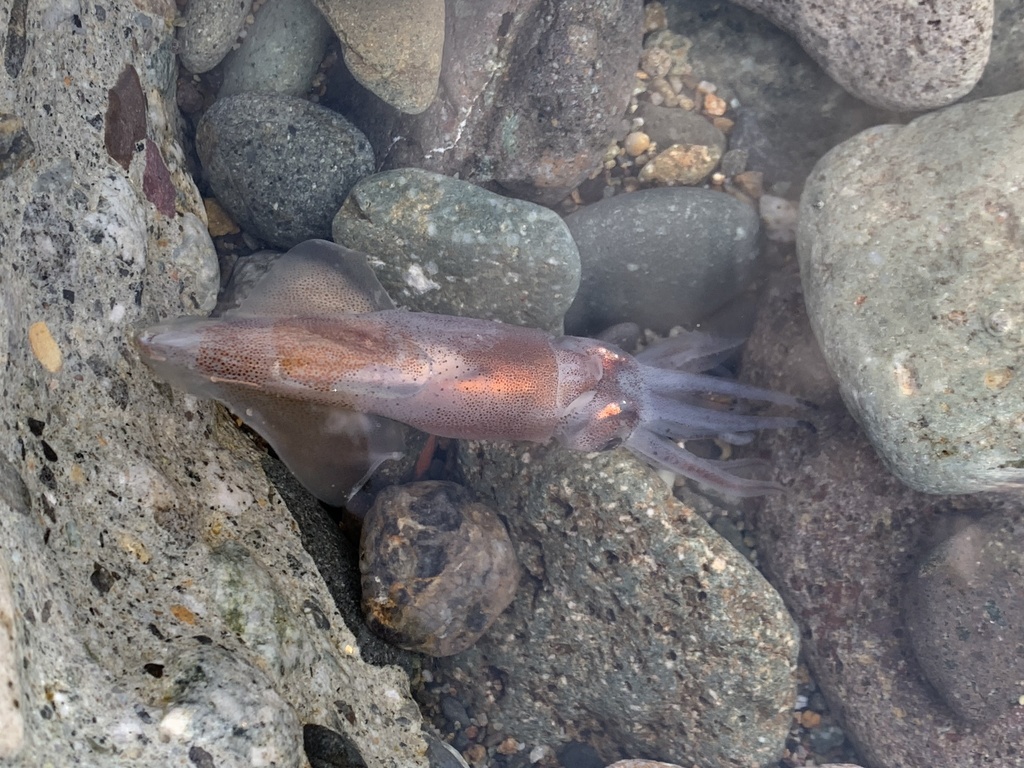
Firefly Squid (Watasenia scintillans) lives in deep Sea across North Pacific Ocean. It feeds on copepods & plankton. Its conservation status is Least Concern.
Fascinating facts about the Firefly Squid
- Eight hundred to a thousand tiny photophores carpet the firefly squid's belly, while three huge ones blaze on each fourth-arm tip, producing a light so bright it can be seen by the naked eye. These organs house luciferin-luciferase crystals arranged in rod-like bodies, which funnels the glow into a downward-pointing cone. This efficient, directed glow lets the squid spot prey and predators below and lure small fish into its strike zone, turning darkness into a hunting lantern.
- An adult firefly squid measures just 7.5 cm (3 in) long, yet it spends most of its year cruising 200-400 m deep before surfacing at night to feed in the dim 20-60 m twilight zone. This daily climb, known as diel vertical migration, exposes the animal to a temperature swing of 3-6 °C by day and 5-15 °C by night. By shifting vertically, the squid follows its prey and avoids daytime predators, turning a tiny body into a seasonal commuter of the deep.
- The firefly squid lives just one year, and in that brief span it follows a surprisingly monogamous script. Ninety-five percent of examined females stored sperm from a single male, and that male's sperm fertilized every egg she laid. Males, meanwhile, produce enough sperm for only two to three matings, a limit reinforced by a skewed sex ratio that leaves few opportunities for re-mating. This tight pairing ensures each generation's genetic legacy is passed on by a single partnership, a rarity among cephalopods.
- Japan's fishers haul between 4,804 and 6,822 tons of firefly squid each year, a catch recorded throughout the 1990s. The bright blue flash of their photophores makes them a prized table-side delicacy and a magnet for night-time tourists watching Toyama Bay glow.
- Unlike any other squid, the firefly squid's retina houses three separate visual pigments: retinal (A1) peaking at 482 nm, hydroxyretinal (A4) at 470 nm, and dehydroretinal (A2) at 500 nm. This trio, each locked in its own photoreceptor cell, likely grants the animal true color discrimination, a trait seen only in organisms with multiple retinal pigments.
Sources
Every fact above was checked against these pages, and kept only where one of them states it.
At a glance
RangeNorth Pacific Ocean
HabitatDeep Sea
DietCopepods & plankton
About the Firefly Squid
In the dark, mysterious depths of the ocean, the firefly squid ignites the darkness with a mesmerizing display of bioluminescence, its tiny body aglow with a constellation of sparkling lights that dance across its skin like a celestial map. As it moves through the water, its ethereal glow leaves a trail of shimmering breadcrumbs, a fleeting glimpse into the secret life of this enigmatic creature. With each undulation of its mantle, the firefly squid weaves a hypnotic spell, its luminous beauty casting a spell of wonder over all who are fortunate enough to behold it.
Hear the Firefly Squid, and 4,400+ more
Real recorded sounds, 11 nature games and a free Daily 5, 1v1 quiz duels, conservation wins and a safe Kids mode. Free on Feravox.
More ocean life to discover