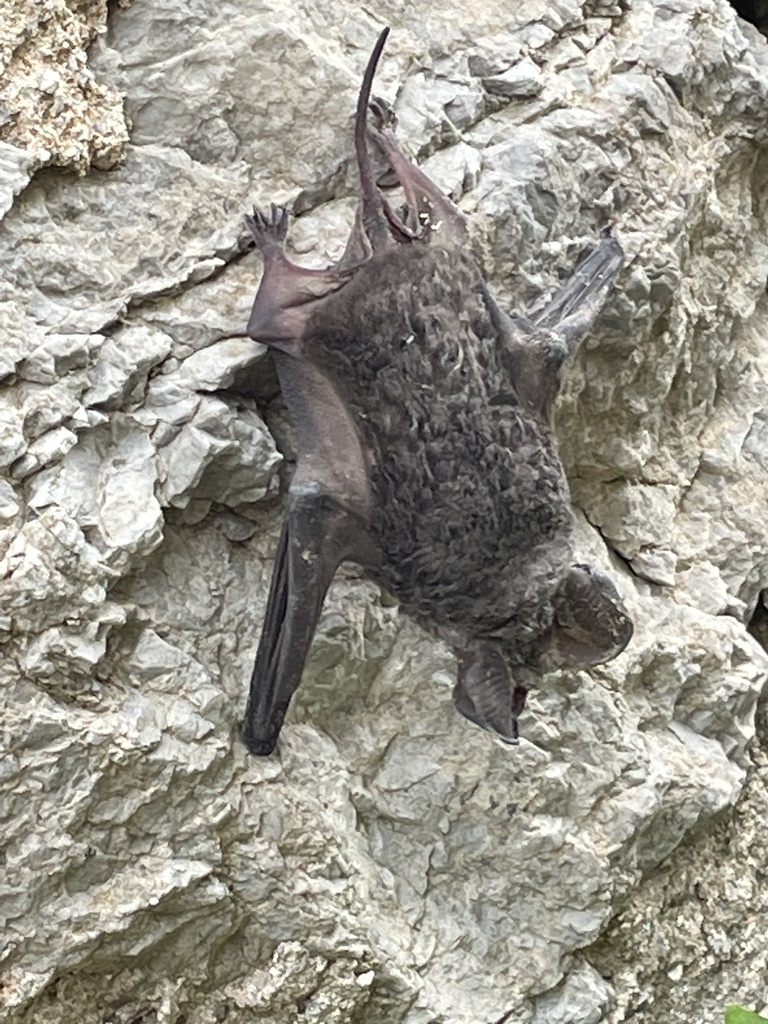
European Free-tailed Bat (Tadarida teniotis) lives in temperate mountainous regions across Southern Europe and Africa. Its conservation status is Least Concern.
Hear the European Free-tailed Bat
A real field recording of the European Free-tailed Bat, made in the wild.
Fascinating facts about the European Free-tailed Bat
When dusk falls, the bat darts straight upward instead of the erratic loops typical of many bats, cruising at great heights for up to ten hours without a pause. Before leaving its roost it makes a rattling sound and often emits a characteristic "tsick-tsick" in flight, a vocal signature that lets observers identify it even when it's high above the canopy.
European free-tailed bats begin their nightly hunt 39-65 minutes after sunset and keep buzzing for a solid ten-hour stretch. Their echolocation clicks peak at 11-6 kHz, have a narrow 12-18 kHz bandwidth and last about 15 milliseconds, a low-frequency, long-duration pulse that slices through the night air.
Moth lovers, take note: in France, Israel and Kyrgyzstan the bat's diet is up to 88 % moths by volume, with beetles, neuropterans and hemipterans filling the rest. Its low-frequency echolocation avoids the hearing range of tympanate insects, letting it silently swoop on moths that would otherwise hear higher-pitched bat calls.
Foraging trips can stretch 5-15 km from the roost, and while many individuals roost alone, colonies can swell to up to 160 bats. Each bat defends a tiny personal territory within the group by shouting loud vocalizations.
A European free-tailed bat fits on a ruler: its head-body measures about 3.5 inches (89 mm), its tail 2 inches (51 mm) and it weighs between 1 and 2 ounces (28-57 g). still carrying a robust, fleshy tail that isn't bound to a membrane.
Sources
Every fact above was checked against these pages, and kept only where one of them states it.
As dusk descends, the European Free-tailed Bat takes to the evening skies, its sleek, dark form slicing through the air with a fluidity that belies its rapid, erratic movements, as it pursues the swarms of insects that dance in the fading light. With a series of swift, agile turns, it navigates the complex landscape of trees and buildings, its high-pitched calls echoing through the darkness as it communicates with its colony. In this nocturnal world, the European Free-tailed Bat is a master of the hunt, its remarkable agility and acute echolocation guiding it with unerring precision through the shadows.
Advertisement
Hear the European Free-tailed Bat, and 4,400+ more
Real recorded sounds, 11 nature games and a free Daily 5, 1v1 quiz duels, conservation wins and a safe Kids mode. Free on Feravox.