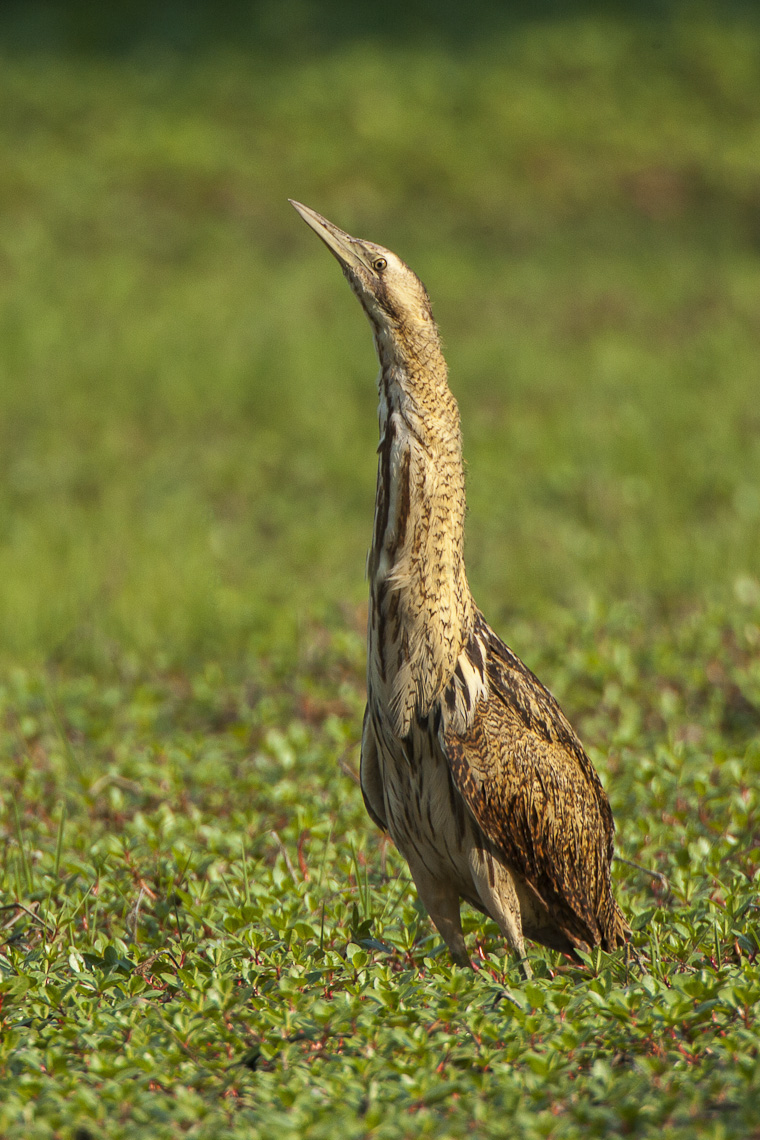
Eurasian Bittern (Botaurus stellaris) lives in freshwater wetlands across Europe Asia. It feeds on fish and frogs. Its conservation status is Least Concern.
Hear the Eurasian Bittern
A real field recording of the Eurasian Bittern, made in the wild.
At up to 81 cm long, the Eurasian bittern stretches longer than a school ruler, while its wings span the width of a compact car door at 100-130 cm. It weighs as much as a sack of flour, 0.87-1.94 kg, making it the biggest of its secretive relatives. This size lets it stride through dense reeds without sinking, but also demands large wetland patches for hunting and nesting, linking its survival to the health of extensive marshes.
In the United Kingdom the bittern went from 11 recorded males in 1997 to 228 breeding males in 2021,. The jump from 44 breeding pairs in 2007 to over 200 males a few years later shows how targeted reed-bed restoration can revive a species once thought lost, turning a local extinction into a conservation success story.
When startled, the bittern points its bill straight up and freezes, letting its streaked brown plumage merge with reeds, a tactic called bitterning. If a predator approaches, it can also sway its body so the stripes line up with surrounding stems, creating the illusion of wind-blown reeds.
A male's boom can be heard five kilometres away on a calm night, and the bird forces air from its oesophagus, using powerful surrounding muscles. and lets researchers count individuals by tallying distinct booms during surveys.
Globally, there are between 110,000 and 340,000 Eurasian bitterns, a figure that sounds healthy but masks a slow decline as wetlands disappear. The IUCN still lists the species as "least concern,".
Sources
Every fact above was checked against these pages, and kept only where one of them states it.
In the misty dawn of a wetland, the Eurasian Bittern emerges as a phantom, its mottled plumage blending seamlessly with the reeds as it moves with deliberate slowness, its long neck twitching with each cautious step. With a patient, almost meditative air, it probes the water's edge, its sharp bill poised to strike at the unsuspecting fish and frogs that inhabit this murky world. As it freezes, motionless, its very stillness becomes a testament to its remarkable adaptability, a masterclass in stealth and survival in a realm of tangled vegetation and treacherous waters.
Advertisement
Hear the Eurasian Bittern, and 4,400+ more
Real recorded sounds, 11 nature games and a free Daily 5, 1v1 quiz duels, conservation wins and a safe Kids mode. Free on Feravox.