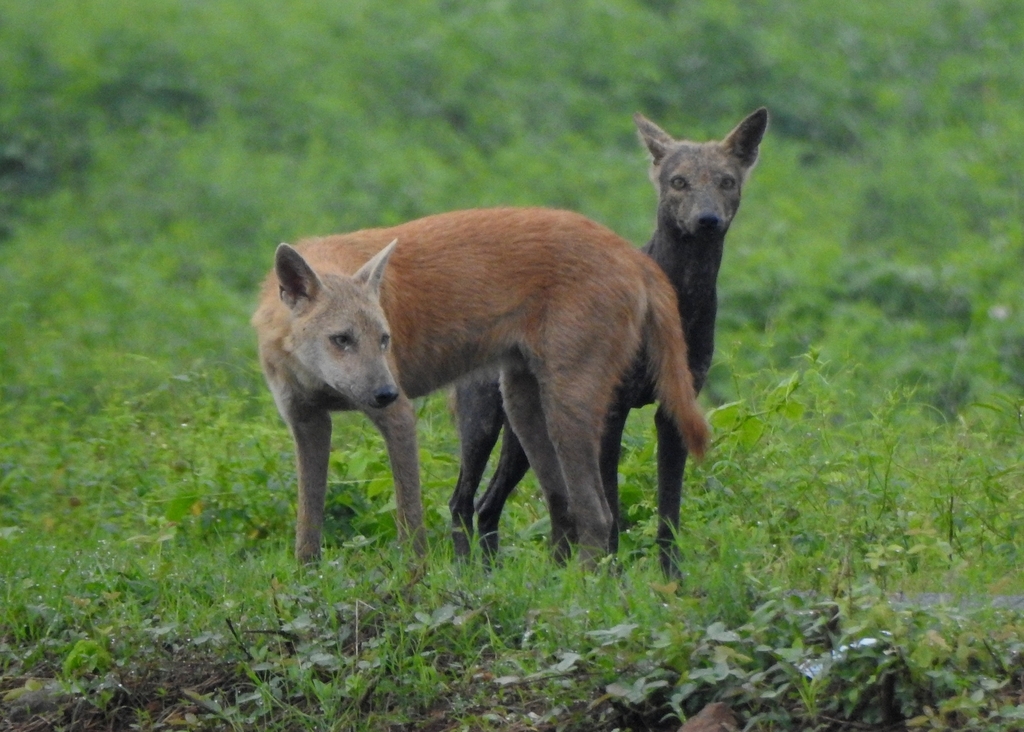
Domestic Dog (Canis familiaris) lives in human environments across Worldwide. It feeds on meat and kibble.
Fascinating facts about the Domestic Dog
- Dogs were the first species to be domesticated over 14,000 years ago, predating agriculture, and genetic studies suggest the process may have begun over 25,000 years ago. The earliest confirmed domesticated dog was buried with humans in Bonn-Oberkassel 14,223 years ago, showing that humans valued dogs before they could even be useful for work.
- There are around 450 official dog breeds, the most of any mammal, and breed skull, body, and limb proportions display more phenotypic diversity than the entire order Carnivora. Most breeds were derived from small numbers of founders within the last 200 years, a rapid artificial selection that reshaped the canine skeleton for everything from mastiff size to dachshund short legs. This burst of diversity illustrates how human preferences can rewrite an entire species' anatomy.
- Dogs have roughly forty times more smell-sensitive receptors than humans, ranging from about 125 million to nearly 300 million in some breeds such as bloodhounds, and can hear sounds up to four times farther, detecting noises from about 400 m (1,300 ft) away versus 90 m (300 ft) for people. This sensory edge lets dogs locate mates and sense environmental changes far beyond human capability, underpinning their role as hunters.
- Dogs vary from the Great Dane, weighing 50-79 kg (110-174 lb) and standing 71-81 cm (28-32 in) tall, to the Chihuahua, at just 0.5-3 kg (1.1-6.6 lb) and 13-20 cm (5.1-7.9 in) high. Despite this size spread, all healthy dogs share the same number of bones (except the tail). Such skeletal uniformity across extremes shows how a single species can be molded for vastly different tasks, from guarding estates to fitting in a pocket, while retaining a common anatomical blueprint.
- The global dog population is estimated at 700 million to 1 billion. Roughly 75 % of those dogs live in developing countries, often as feral or street dogs, while only about 20 % are in developed nations.
Sources
Every fact above was checked against these pages, and kept only where one of them states it.
At a glance
RangeWorldwide
HabitatHuman environments
DietMeat and kibble
About the Domestic Dog
As the domestic dog pads silently through its domain, its tail a metronome of excitement, it embodies a unique amalgam of wild instinct and gentle devotion. With an effortless gait, it navigates the complex landscape of human emotions, ever attuned to the subtle cues of its pack, and responding with a depth of feeling that is at once remarkable and deeply familiar. In its joyful abandon, we see a reflection of our own capacity for love and connection, a testament to the profound bond that has evolved between our species over millennia.
Hear the Domestic Dog, and 4,400+ more
Real recorded sounds, 11 nature games and a free Daily 5, 1v1 quiz duels, conservation wins and a safe Kids mode. Free on Feravox.