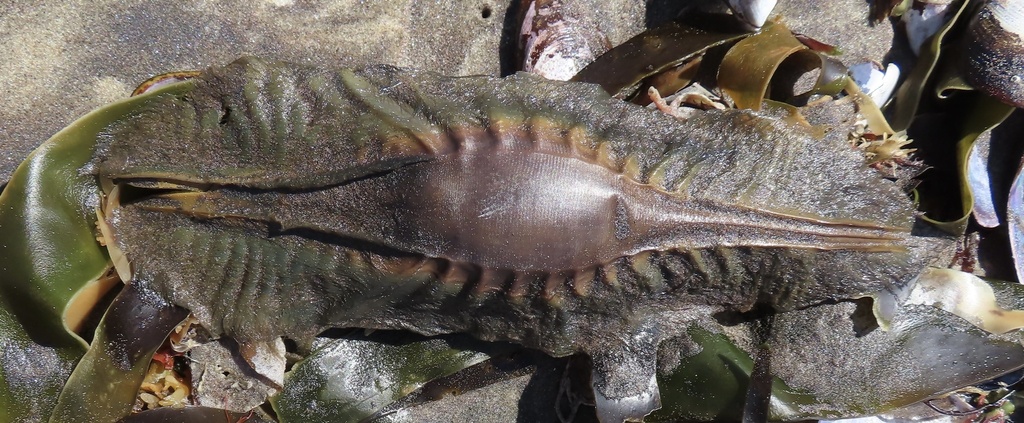
Photo: Nelson Balcar
Feravox · The Voice of the Wild
Cape Elephantfish
Callorhinchus capensis
Least Concern
Cape Elephantfish (Callorhinchus capensis) lives in cold murky soft-bottom bays across South African coastal waters. Its conservation status is Least Concern.
The Cape elephantfish (Callorhinchus capensis) glides through the cold, murky bays of South Africa’s continental shelf, its silver-to-bronze body brushed with a faint yellow hue. Adults range from 45 to 120 cm (1.48–3.94 ft) and weigh 3–5 kg, females typically outsize the males. A dark mid-back band is bisected by two widely spaced dorsal fins; the first bears a long, serrated, venomous spine that projects free for three-quarters of its length, while the second, slightly longer, trails behind the pelvic fins. Its heterocercal tail, with the vertebral column extending into the upper lobe, and enlarged pectoral fins betray a life spent hovering near the soft substrate, a classic deep-water, slow-moving adaptation. The most striking feature is its proboscis – a flat, cartilage-based snout ending in a narrow, curved tip capped by a three-times-as-long-as-broad skin flap, used to probe the sand for prey. At night, this nocturnal hunter uses the proboscis to uncover bivalves such as Phaxas decipens, crustaceans, occasional gastropods like Nassarius speciosus, polychaetes, and even the Southern African anchovy (Engraulis capensis). A surprising twist lies in its reproductive arsenal: males sport an 8.9 cm (3.5 in) claspers and a frontal tenaculum covered in denticles, while females develop a nidamental gland and a translucent, green semen plug that softens as the eggs mature, each leathery case measuring about 18 cm (7.1 in) with a frilled edge.
Real recorded sounds, 11 nature games and a free Daily 5, 1v1 quiz duels, conservation wins and a safe Kids mode. Free on Feravox.