Photo: Charlotte Kirchner
Feravox · The Voice of the Wild
Brown Stingray
Bathytoshia lata
Vulnerable
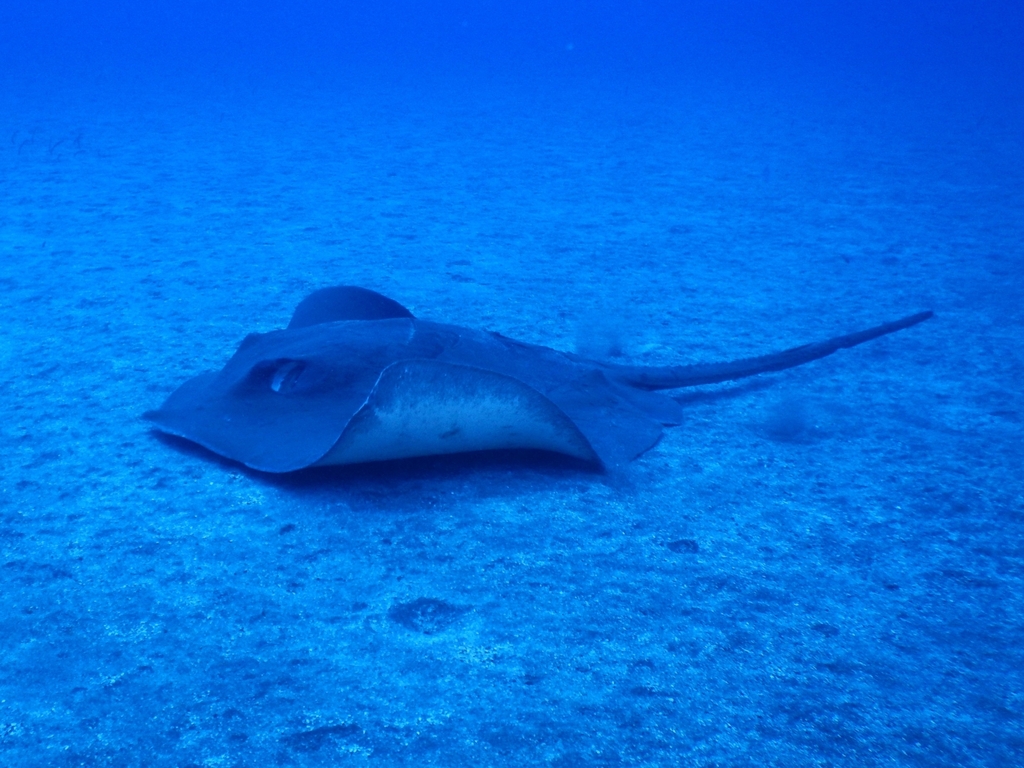
Brown Stingray (Bathytoshia lata) lives in sandy or muddy flats across Indo-Pacific, Atlantic. It feeds on bottom crustaceans and fish. Its conservation status is Vulnerable.
The broad stingray, Bathytoshia lata, glides over the soft seafloor with a striking diamond-shaped disc that is a fourth wider than it is long, its olive-brown dorsal surface fading to a crisp white belly. At up to 1.5 m (5 ft) across and 56 kg (123 lb), its long, whip-like tail bears a serrated spine and a narrow ventral fin fold that widens into a keel, while larger individuals sport three elongated tubercles along the middle of their backs. This benthic predator favors sandy or muddy flats from 40 m to 200 m depth, occasionally diving as deep as 800 m, in the Indo-Pacific, the eastern Atlantic, and even the Mediterranean, where it roams the coastal bays and reef edges of places as distant as southern Africa and Hawaii. By day it lies half-buried, barely stirring, but as sunset fades the ray awakens, covering an average of 0.83 km² each night as it excavates pits to uncover crustaceans, polychaete worms, and small bony fish. Its foraging near reef boundaries draws opportunistic jacks, and its diet is complemented by a suite of tapeworm parasites. A surprising trait revealed by tracking in Kaneohe Bay is its lack of tidal fidelity, despite inhabiting deeper waters, its nightly movements are driven more by temperature and the two-hour window after sunset than by the rise and fall of the tide.
Real recorded sounds, 11 nature games and a free Daily 5, 1v1 quiz duels, conservation wins and a safe Kids mode. Free on Feravox.