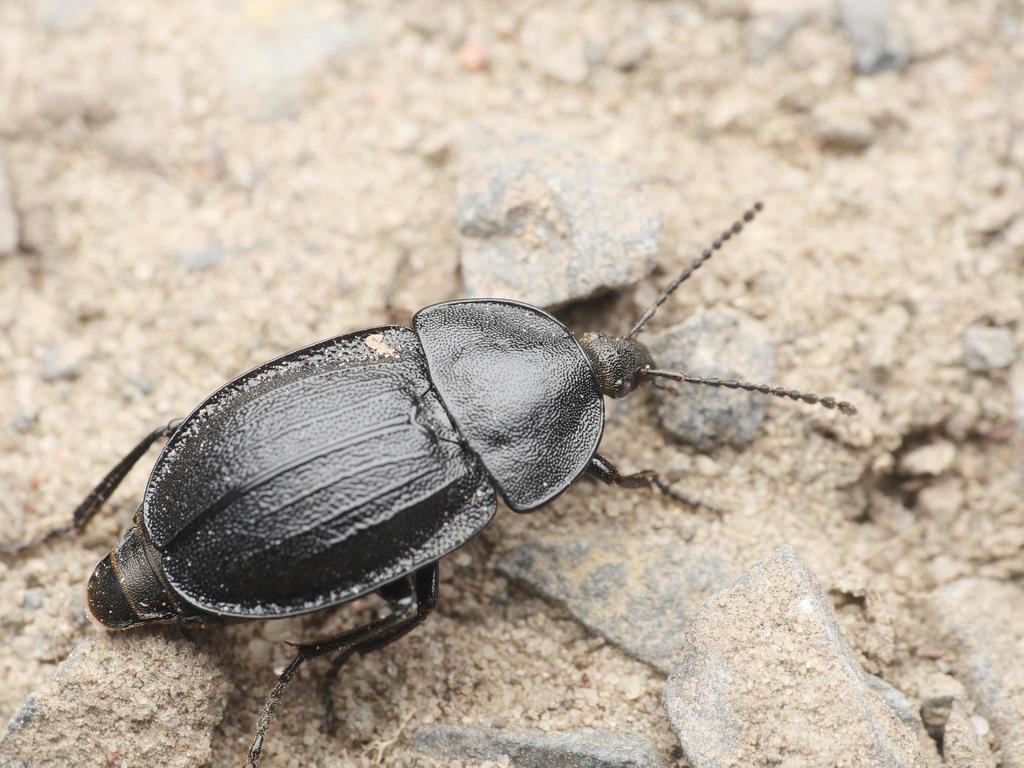
Black Snail Beetle (Phosphuga atrata) lives in moist forests across Europe, North America. It feeds on snail shells and.
Fascinating facts about the Black Snail Beetle
- Up to 15mm long, the black snail beetle is tiny enough to slip under bark yet large enough to crack open snail shells with its unusually long neck. Adults are flightless, lacking flight muscles, so they hunt at night and hide during the day, often under bark. This combination of size, nocturnal habit and flightlessness makes them hard to spot, explaining why they are "seldom encountered by people". Their secretive lifestyle hides a predator that can reach into shells and liquefy prey with a sprayed digestive fluid, showing how evolution can trade flight for a specialized feeding tool.
- When hunting, the beetle extends an elongated neck to slip its head into a snail's shell and then sprays a digestive fluid that breaks down the snail's body inside the hard shell. This method lets a 15mm beetle eat prey that would otherwise be inaccessible, turning a hard-shelled gastropod into a liquid meal. When disturbed the beetle excretes a yellow fluid and retracts its head under the shield.
- Taxonomically, the black snail beetle has been shuffled among many genera since its first description by Linnaeus in 1758, reflecting centuries of confusion over its relationships. It has been placed in Silpha, allied with the unrelated Peltis, and given at least eight different names, yet today all are consolidated under Phosphuga atrata. This taxonomic history highlights how its unusual morphology, flightlessness, elongated neck, and shell-eating habit.
- The larvae of Phosphuga atrata are flattened, black with brown edges to their armor plates, and they also feed on snails. After feeding, the larvae pupate in the ground.
- Phosphuga atrata boasts a trans-Eurasian range that stretches from the United Kingdom across Russia, through Central Asia, into Korea, Japan and even an introduced population in Iceland.
Sources
Every fact above was checked against these pages, and kept only where one of them states it.
At a glance
RangeEurope, North America
HabitatMoist forests
DietSnail shells and
About the Black Snail Beetle
In the damp, moss-shrouded recesses of ancient forests, the black snail beetle glides silently, its dark, polished carapace merging seamlessly with the shadows as it pursues its sluggish prey. With an unhurried deliberation, it navigates the intricate topography of leaf litter and decaying wood, its sensitive antennae twitching like delicate fingers as it tracks the faint trails of its gastropod quarry. As it moves, the beetle's very presence seems to embody the patient, unobtrusive persistence of the natural world, a reminder that even in the most obscure and forgotten corners, life abounds.
Hear the Black Snail Beetle, and 4,400+ more
Real recorded sounds, 11 nature games and a free Daily 5, 1v1 quiz duels, conservation wins and a safe Kids mode. Free on Feravox.
More insects and spiders to discover