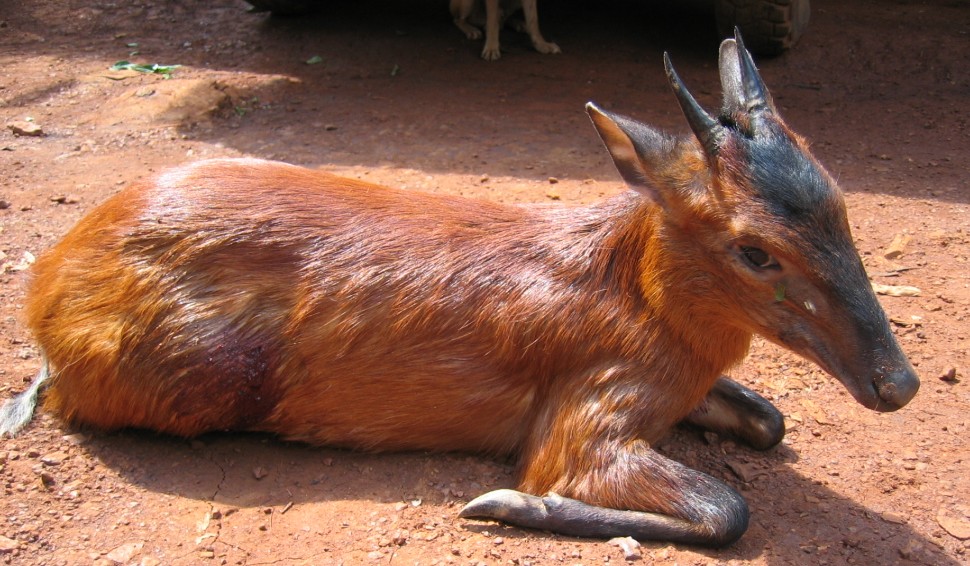
Black-fronted Duiker (Cephalophorus nigrifrons) lives in montane forest across Eastern Africa. It feeds on leaves and fruits. Its conservation status is Least Concern.
Fascinating facts about the Black-fronted Duiker
- A bold black stripe runs from the nose to the forehead, giving the black-fronted duiker its name and distinguishing it from its congeners. Its glossy coat ranges from deep reddish-mahogany to a lighter orange-chestnut, with sparser, darker hair on the long legs, a short black tail with a white tip, and it weighs 14-18 kg and stands 43 cm at the shoulder.
- Both males and females bear short, pointed horns that measure 4-12 cm in length, a size that suits the duiker's modest stature. These horns are employed to fend off rival duikers and predators, providing a means of defence in their forest environment. The species' overall compactness is reflected in its 43 cm shoulder height and 14-18 kg body mass, traits that together support its ability to navigate dense undergrowth.
- Its elongated hooves appear to be an adaptation to the wet habitats it seems to prefer, helping it move through soggy ground. The black-fronted duiker inhabits montane, lowland and swamp forests from sea level up to 3 500 m, frequently being recorded in marshes or along river and stream margins. This combination of foot structure and habitat choice enables the species to thrive in the water-logged forests of central and west-central Africa.
- While most of its range stretches across central Africa, a separate group lives in the Niger Delta of eastern Nigeria, isolated from the main populations. The main range continues from southern Cameroon eastward to western Kenya and southward to northern Angola, covering a broad swath of central and west-central Africa. Within this expanse the duiker inhabits montane, lowland and swamp forests, from sea level up to 3 500 m, often favouring marshes and river margins.
- Pairs occupy and defend exclusive territories, marking the borders with secretions from their facial glands. Each monogamous pair maintains habitual paths that link sleeping sites with feeding areas, allowing them to be active both day and night while browsing on foliage and also feeding on fruit when available.
Sources
Every fact above was checked against these pages, and kept only where one of them states it.
At a glance
RangeEastern Africa
HabitatMontane forest
DietLeaves and fruits
About the Black-fronted Duiker
In the dappled shadows of the forest, the black-fronted duiker moves with stealthy elegance, its large eyes watchful and alert as it navigates the dense undergrowth with a quiet confidence. With each delicate step, its slender legs seem to barely touch the earth, as if it is floating across the forest floor, its reddish-brown coat blending seamlessly into the surroundings. As it pauses to nibble on a tender shoot, the duiker's very stillness seems to embody the essence of the forest, a fleeting glimpse of a secret world that lies just beyond our reach.
Hear the Black-fronted Duiker, and 4,400+ more
Real recorded sounds, 11 nature games and a free Daily 5, 1v1 quiz duels, conservation wins and a safe Kids mode. Free on Feravox.